

Is Teak or Aluminum Better for Outdoor Furniture?
Last Updated: October 24, 2026
Quick Summary
The teak vs aluminum choice comes down to upkeep versus longevity: teak needs annual oiling but can last for decades and stays cooler in sun, while aluminum needs only occasional washing and suits busy, full-sun patios. Aluminum usually costs less upfront, but teak can win on cost per year over a long horizon.
- Teak needs one oiling per year to keep its honey-brown color; untreated, it fades to a silvery patina.
- Aluminum durability depends on its powder coating, so touch up chips before corrosion starts.
- Teak is heavy and hard to move alone, while a comparable aluminum chair can be carried one-handed.
- Bare aluminum can feel hot in direct sun; light-colored coatings stay cooler than dark ones.
- Choose aluminum for full-sun decks and frequent rearranging, and teak for covered patios and heirloom pieces.
Table of Contents
- Teak vs Aluminum: The Core Trade-Offs at a Glance
- Durability and Expected Lifespan of Each Material
- Teak Furniture Maintenance: What Annual Oiling Really Involves
- Aluminum Outdoor Furniture Durability: Powder Coating, Corrosion and Wear
- The Cost of Teak vs Aluminum Furniture Over Time
- Weight, Comfort and Heat in Direct Sun
- The Best Material for Outdoor Dining Furniture by Use Case
- Choosing Your Teak or Aluminum Pieces at Spirit of Willow
- Frequently Asked Questions
Teak vs Aluminum: The Core Trade-Offs at a Glance
Choosing between teak and aluminum comes down to a simple trade: teak asks for care and rewards you with warmth and longevity, while aluminum asks for almost nothing and rewards you with effortless seasons.
Teak is a dense tropical hardwood rich in natural oils that repel water and resist rot and insects. Aluminum is a lightweight metal that never rusts through and typically carries a powder-coated finish for color and protection.
Below, we compare durability, maintenance, long-term cost, weight, comfort, and the best use cases for each. The goal is not to crown a universal winner. It is to tell you which material wins for your specific patio.
Side-by-Side Comparison Table
| Factor | Teak | Aluminum |
|---|---|---|
| Weight | Heavy, hard to move alone | Light, easy to reposition |
| Weather resistance | Natural oils repel moisture | Powder coating blocks corrosion |
| Maintenance | Annual oiling to keep color | Occasional wash with soap and water |
| Aging look | Silvery patina if left untreated | Holds finish until coating wears |
| Heat in sun | Stays cooler to the touch | Can get hot in direct sun |
| Repairability | Sandable and refinishable | Touch-up paint for chips |
| Best for | Heirloom pieces, covered patios | Busy households, full-sun decks |
Durability and Expected Lifespan of Each Material
Teak generally outlasts aluminum in raw years of service, but aluminum holds up better with zero attention. A well-made teak piece can serve for decades when it is oiled and kept from standing water.
Construction matters more than the material label. For a broader framework on judging build quality, see our guide on how to choose durable outdoor furniture.
Watch out: the weak point on cheap aluminum is the coating, not the metal. Once it chips, moisture gets underneath and corrosion starts at the exposed edge.
Teak Furniture Maintenance: What Annual Oiling Really Involves
Teak furniture maintenance is modest but real: plan on one oiling per year to keep the honey-brown color, plus a wash a few times a season. Left alone, teak fades to a soft silvery patina. That look is popular and entirely healthy, but it is a choice, not neglect.
Here is the routine in practice:
- Clean the surface with mild soap and water, then let it dry fully
- Apply a thin coat of teak oil with a cloth, working with the grain
- Wipe off excess so it does not stay tacky
- Repeat once a year, ideally before the outdoor season
If a full annual ritual sounds like too much, our guide to low-maintenance patio furniture materials covers options that ask for even less.
Aluminum Outdoor Furniture Durability: Powder Coating, Corrosion and Wear
Aluminum outdoor furniture durability rests almost entirely on its powder coating. The metal itself does not rust the way steel does, but the protective layer is what keeps the finish intact and the frame looking new.
Care is simple: rinse with soap and water, and touch up any chip before it spreads. Avoid abrasive cleaners that dull the coating. As the Aluminum Association's guidance on finishes notes, surface preparation before coating is what separates a finish that lasts from one that peels.
The honest limitation: aluminum dents. A dropped chair or a hard knock can leave a ding that teak would shrug off.
The Cost of Teak vs Aluminum Furniture Over Time
The cost of teak vs aluminum furniture flips depending on how long you keep it. Aluminum usually costs less upfront. Teak costs more to buy, but a cared-for set can serve for decades, which spreads that price across many more seasons. The real comparison is cost per year of use, not the sticker on the tag.
Most ranking pages stop at that sentence. The useful version is a lifecycle cost model with the assumptions written down, so you can plug in your own numbers instead of trusting a broad claim about "value." Here is the framework we recommend.
The five cost buckets to add up
- Purchase price. The sticker for the piece or set, including delivery and assembly if charged separately.
- Maintenance supplies. For teak: teak oil or sealer, applicator cloths, mild soap, and a soft brush. For aluminum: mild soap, a soft brush, and touch-up paint for chips.
- Refinishing labor or cost. Teak that is kept honey-brown needs a light sanding and re-oil roughly once a year; a full refresh every few years. Aluminum needs spot touch-ups only when the powder coating chips.
- Repairs. Teak can be sanded, plugged, and re-glued; aluminum can be touched up or, in serious dents, replaced at the frame level. Budget a small annual repair reserve for either.
- Replacement or disposal. Teak has resale and refinishing value; aluminum is widely recyclable but has low scrap value at the consumer level.
A transparent way to run the math
- Decide your expected holding period in years (5, 10, 20).
- Add purchase price plus the estimated lifetime cost of supplies and refinishing.
- Divide by the holding period to get cost per year.
- Compare that number, not the sticker, across materials.
A common pattern: aluminum wins on cost per year over a short horizon because upkeep is nearly free, while teak closes the gap and can pull ahead over a long horizon because the frame does not need replacing and refinishing restores rather than replaces. The crossover point depends on how much you value your own maintenance time, price that honestly, even at a modest hourly rate.
For a deeper look at why quality pieces carry higher price tags, read why luxury outdoor furniture is expensive. We do not publish prices here because they vary by piece and configuration; current pricing is on each product page.
Weight, Comfort and Heat in Direct Sun
Weight changes how you live with a set. Teak is heavy, so it stays put in wind but is hard to rearrange alone. Aluminum is light enough for one person to move, which suits flexible layouts and seasonal storage.
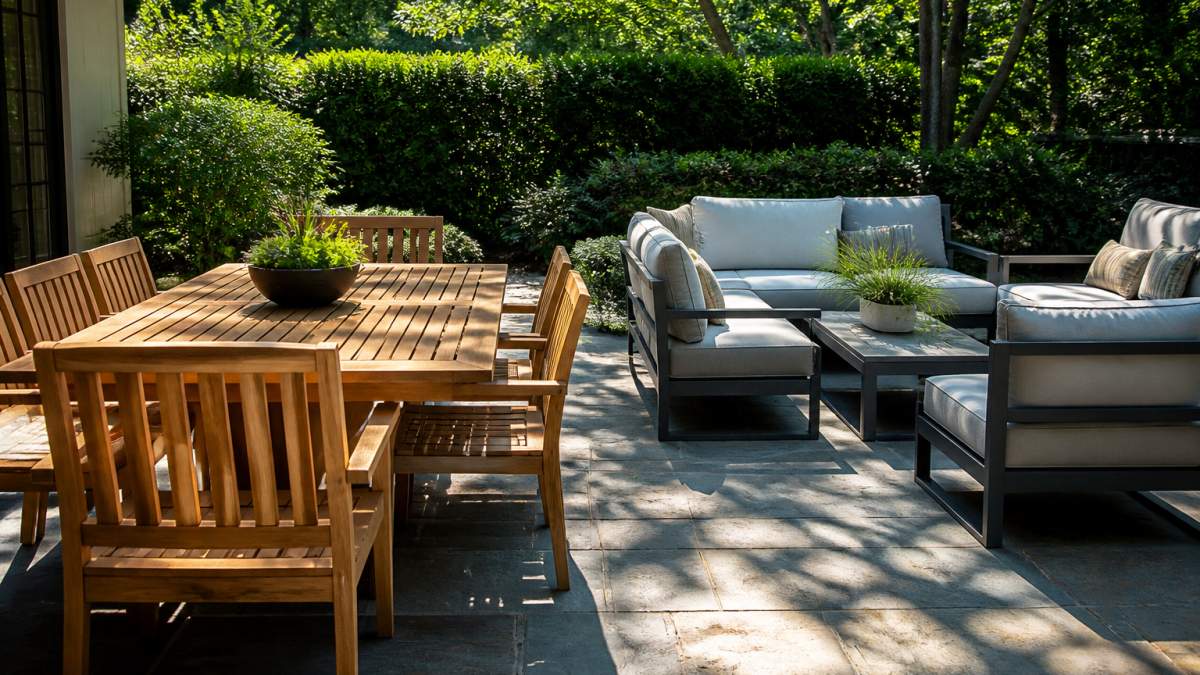
Heat behavior in direct sun
Heat is the underrated factor, and it is where the two materials diverge most in daily use. Bare aluminum conducts heat quickly, so an unpainted or dark-coated frame in strong afternoon sun can feel hot to the touch and uncomfortable against bare skin. Light-colored powder coatings reflect more sun and stay noticeably cooler than dark ones.
The practical fix is the same for either frame: cushions do most of the comfort work, and shade, an umbrella, pergola, or sail, lowers surface temperature on both materials. If your patio gets punishing afternoon sun and you prefer bare frames, teak has the comfort edge; if you always use cushions and shade, the difference narrows.
Cold-weather feel
In cooler months the comparison reverses slightly. Aluminum feels cold to the touch and can be uncomfortable on bare skin in shoulder seasons, while wood feels neutral. Neither material is a problem once cushions are in place, but it is worth knowing if you use the patio year-round.
Ergonomics and cushions
Frame material matters less than frame geometry and cushion quality. Look for seat heights that suit your table, armrests at a comfortable height, and cushions with a firm, quick-drying foam and a removable, washable cover. A quality cushion on an aluminum frame will out-comfort a bare teak bench every time, so budget for cushions on either material rather than treating them as an afterthought.
The Best Material for Outdoor Dining Furniture by Use Case
The best material for outdoor dining furniture depends on your climate and habits, not on a universal ranking. Match the material to the scenario:
| Your situation | Better choice | Why |
|---|---|---|
| Full-sun deck, no cover | Aluminum | Coating handles exposure with little care |
| Covered porch or pergola | Teak | Natural oils thrive with some shelter |
| Busy family, low upkeep | Aluminum | Wash-and-go maintenance |
| Heirloom, design-led patio | Teak | Ages beautifully, refinishable |
| Frequent rearranging | Aluminum | Light and easy to move |
| Coastal, salt air | Aluminum with quality coating | Resists corrosion with rinsing |
Neither material is "best" in the abstract. The right pick is the one that fits how you actually use the space. For a wider set of alternatives, see our guide to alternatives to plastic outdoor furniture.
Choosing Your Teak or Aluminum Pieces at Spirit of Willow
At Spirit of Willow, we curate outdoor pieces meant to turn a patio into a retreat, and we think the teak vs aluminum decision should follow your space, not a trend. Our collection favors quality construction and timeless design, and our outdoor pieces are built to withstand the elements while keeping their beauty over time.
If aluminum fits your low-maintenance, full-sun patio, start with a set to anchor the space. Pair either material with shade, cushions, and a fire pit to make the patio a destination. Customers like Michael T. tell us the attention to detail felt premium from order to delivery, and that is the standard we hold.
Frequently Asked Questions
Which lasts longer outdoors, teak or aluminum furniture?
Both last decades when built well. Teak's natural oils resist rot, insects and moisture, and the wood can be sanded and refinished if it weathers. Aluminum does not rot, and powder-coated frames resist corrosion, though chips in the coating expose bare metal over time. In salt-heavy coastal air, aluminum frames need rinsing and coating checks, while teak handles humidity well but may gray faster. Construction quality, welds and joinery matter as much as the material itself.
Does teak furniture require more maintenance than aluminum?
Yes, teak furniture maintenance takes more effort. To keep teak's honey tone, plan on cleaning and annual oiling with teak oil, usually once a year. Left alone, teak develops a silvery patina that many people prefer, and it still needs occasional cleaning. Aluminum mostly needs soap and water, with touch-ups if the powder coating chips. If you want minimal upkeep, aluminum wins; if you enjoy caring for natural wood, teak rewards the effort.
Does aluminum patio furniture get too hot in the sun?
Bare metal can heat up in direct sun, but powder-coated aluminum stays noticeably cooler to the touch than dark steel or wrought iron. Light-colored finishes reflect more sunlight and feel cooler. Teak also warms without becoming uncomfortably hot. Cushions help either way. If your patio gets full afternoon sun, choose a light finish and add seat cushions for comfortable bare-leg seating.
Is teak furniture worth the higher upfront cost?
The cost of teak vs aluminum furniture favors aluminum upfront, but teak often wins long-term value. Teak's density and natural oils mean it resists rot and insects without chemical treatment, and it can be sanded and refinished rather than replaced. Aluminum is lighter on the budget and easier to move, but coating damage can lead to corrosion. If you plan to keep the set for 15 or more years and value natural aging, teak's price is easier to justify.
The right material is the one that fits your patio, your climate, and the time you want to spend on upkeep. Whichever you choose, Spirit of Willow can help you build a space worth lingering in, with carefully curated outdoor pieces, designs built to withstand the elements, and shipping across much of the country. Get started with Spirit of Willow and turn your patio into a retreat you will use all season.
