

Why Luxury Outdoor Furniture Is Expensive
Table of Contents
- Why Luxury Outdoor Furniture Is Expensive: The Real Cost Drivers
- Material Quality and Weather Resistance
- Craftsmanship, Design, and Build Quality
- How Long Does Outdoor Furniture Last
- Luxury vs Budget Outdoor Furniture: What You're Really Paying For
- Is Expensive Outdoor Furniture Worth It
- Frequently Asked Questions
Last Updated: October 15, 2026
Why Luxury Outdoor Furniture Is Expensive: The Real Cost Drivers
The price gap between a basic outdoor set and a luxury collection is shocking: a simple metal frame with polyester cushions might run $300, while a comparable luxury piece could be $1,500 or more. That's not coincidence or brand markup.
The truth is, luxury outdoor furniture expensive pricing reflects real differences in how pieces are engineered, built, and designed to perform.
The core reason luxury outdoor furniture expensive comes down to five interconnected factors: material quality, weather resistance, frame construction, craftsmanship, and design. A premium aluminum frame costs more than steel but is lighter, more corrosion-resistant, and easier to maintain.
Most budget outdoor furniture is designed to look good for one season; luxury pieces maintain their appearance and structural integrity for five to ten years. That durability premium is baked into every component.
Material Quality and Weather Resistance
Most articles stop at "luxury uses better materials." That's not useful when you're deciding whether an aluminum frame is worth $400 more than steel, or whether solution-dyed acrylic justifies the upgrade over treated polyester. Materials drive cost predictably, and you can trace where your money goes.
Where the money actually goes in a luxury piece
The frame accounts for roughly 30-40% of the wholesale cost of a quality outdoor piece, cushion and fabric another 20-30%, finishing and hardware 10-15%, and the remainder split between labor, packaging, freight, and retail margin. That's why two sofas that look identical online can differ by $800, the cheaper one may use a thinner frame wall, lower-density foam, and a surface-applied fabric finish rather than solution-dyed.
A luxury price usually pays for four compounding things: thicker raw material, more expensive coating chemistry, tighter manufacturing tolerances, and a warranty the manufacturer can afford to honor.
Material-by-material: what you're really trading
Aluminum. The default for high-end outdoor frames. It doesn't rust like steel, is light enough to rearrange alone, and powder-coated or anodized aluminum holds up in coastal salt air better than almost anything at its price.
Teak. The classic premium hardwood. Teak's natural oils make it rot- and insect-resistant, and it weathers to a silver-gray patina if left untreated.
Powder-coated steel. Stronger and stiffer than aluminum at the same thickness, which is why it's common in swivel chairs and rockers that take lateral load.
Stainless steel. Marine-grade stainless (304 or 316) resists corrosion in salt air better than any coated steel, but costs significantly more and is heavy.
Synthetic wicker (PE). High-density polyethylene woven over an aluminum frame is the workhorse of luxury outdoor seating. The material is inexpensive; the cost is in the weave.
Outdoor fabrics. Solution-dyed acrylic (hangtag names include Sunbrella and Outdura) has pigment added to the fiber before extrusion, so color goes all the way through and fading is gradual rather than blotchy.
Climate changes which material is worth paying for
- Coastal salt air: aluminum, stainless hardware, and solution-dyed acrylic. Avoid uncoated steel and untreated hardwood.
- Intense sun and heat: solution-dyed acrylic fabric and powder-coated or anodized frames. Olefin and topical-treated polyester will fade noticeably within a season or two.
- Freeze-thaw cycles: aluminum or powder-coated steel with fully welded joints; wood that absorbs water can crack as it expands and freezes.
- High humidity: aluminum frames, quick-drying foam, and mesh or sling seating that doesn't trap water.
- High wind: heavier frames (steel or teak) or modular pieces you can anchor or stack.
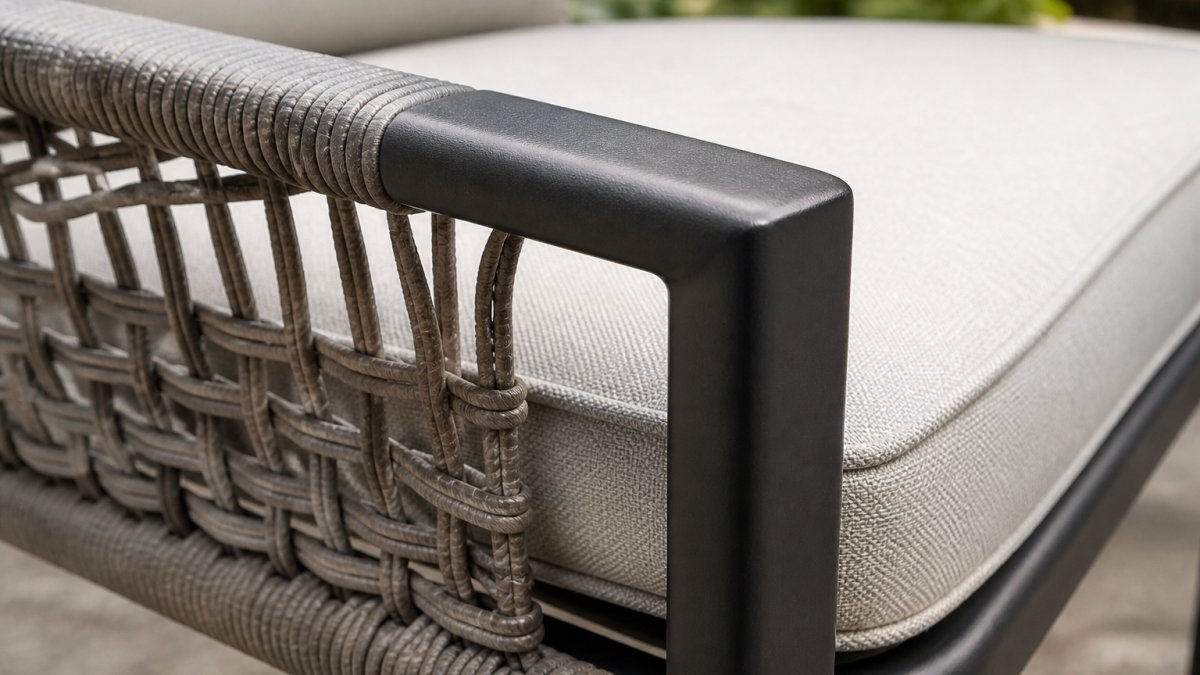
The point isn't that one material wins. The price premium only makes sense when the material matches your climate and how hard you'll use the piece. A $2,000 teak set in a desert climate is overkill; a $600 aluminum set on a salt-sprayed balcony is a bargain. Selecting the right frame is only half the battle, as the longevity of your investment often hinges on the performance of premium fabrics that must withstand the same environmental stressors.
Craftsmanship, Design, and Build Quality
Luxury outdoor furniture expensive pricing also reflects the time and skill involved in assembly and finishing. Hand-woven PE wicker is woven by hand or semi-automated machinery that mimics hand techniques, and its weave density, consistency, and pattern quality far exceed injection-molded or loosely woven alternatives.
Design in luxury pieces goes beyond aesthetics. Every curve, angle, and proportion serves both visual appeal and functional comfort: armrests positioned to support arms naturally, seat depth and angle engineered for lounging without sliding, and back support following ergonomic principles budget pieces often ignore.
Finishing adds cost too. Luxury pieces often get multiple coats of protective sealant or stain, hand-sanded transitions, and attention to details like how fabric wraps around corners or legs meet the frame. These touches don't affect function, but they signal quality and extend material lifespan.
How Long Does Outdoor Furniture Last
Lifespan claims are everywhere, but the number that matters is cost per year of use, and that number is only honest when you include maintenance, cushion replacement, and repair. Here's how to build it.
7 Piece Outdoor Patio Furniture Set, Patio Furniture Set with Fire Pit Table →
Realistic lifespans by tier
- Budget (under roughly $500 for a set): one to two seasons of acceptable appearance. Cushions fade or mildew, frames develop rust spots, and by year three most pieces look worn or have functional problems.
- Mid-range ($500-$1,500): three to five years with basic care. Frames usually hold; cushions are the first thing to go.
- Luxury ($1,500+): five to ten years, and often longer for the frame itself if you replace cushions and covers on schedule. A powder-coated aluminum or stainless frame can outlive two or three sets of cushions.
The cost-per-year math, done properly
A $300 budget set lasting two years is $150 per year, but that ignores replacement cushions in year two (often $80-$150 for a full set), cleaning products, and shopping time. Realistically, that set costs closer to $200 per year.
A $1,500 luxury set lasting eight years is about $187 per year before maintenance. Add one cushion replacement around year five ($200-$400) and fabric cleaner each season, and you land near $230-$250 per year. The gap narrows to almost nothing, and you spent those eight years on better foam, better fabric, and a frame that didn't wobble.
The costs nobody puts on the tag
- Cushion replacement: the biggest recurring cost. Budget cushions may need replacing every one to two years; quality solution-dyed acrylic covers and high-density foam typically last four to six years with proper storage.
- Fabric protection and cleaning: a few dollars a season for the right cleaner, more if you re-treat water repellency.
- Frame touch-ups: powder-coated steel may need chip repair to prevent rust; aluminum and teak generally don't.
- Hardware and fasteners: stainless hardware lasts; cheaper zinc-plated fasteners can corrode and seize, making disassembly for storage difficult.
- Storage or covers: if you don't have covered storage, quality covers are a real line item, and they extend every other component's life.
Repairability is the hidden multiplier
A piece you can repair lasts longer for less. Modular construction, replaceable cushions, removable covers, bolt-together frames, available parts, separates a ten-year piece from a three-year piece, regardless of original price. Before you buy, ask: Can I buy replacement cushions in two years? Are covers removable and washable? Can I get a replacement leg, arm, or fastener?
If the answer to all three is no, you're buying a disposable piece no matter what the price tag says. If the answer is yes, the higher upfront cost is doing real work.
Warranty as a lifespan signal
Warranties are a manufacturer's own bet on how long the product will last. A one-year frame warranty tells you something; a five- to ten-year frame warranty, with a shorter term on fabric and cushions (normal, since fabric wears faster), signals the maker expects the structure to survive.
When you run the full cost-per-year calculation, purchase price, cushions, cleaning, repairs, and years of use, the gap between budget and luxury often shrinks to a few dollars a month. The question stops being "is luxury worth it" and becomes "do I want those years on better foam and fabric, or replace the set twice."
Luxury vs Budget Outdoor Furniture: What You're Really Paying For
The gap between luxury and budget outdoor furniture isn't arbitrary. It reflects real engineering, material science, and construction quality.
| Aspect | Budget Furniture | Luxury Outdoor Furniture |
|---|---|---|
| Frame Material | Basic steel or aluminum | Powder-coated steel, anodized aluminum, or stainless steel |
| Cushion Fabric | Standard polyester | Solution-dyed acrylic or high-performance olefin |
| Foam Density | 15D-20D | 28D or higher |
| Weave/Construction | Loose or injection-molded | Hand-woven or precision-engineered |
| Expected Lifespan | 1-2 seasons | 5-10 years |
| Weather Resistance | Basic protection | Engineered for UV, moisture, temperature cycles |
| Repairability | Limited or impossible | Modular; individual components replaceable |
| Maintenance | Frequent cleaning, sealing | Minimal; removable covers washable |
| Cost Per Year | $150-200 | $150-250 |
Budget furniture prioritizes initial affordability. Luxury outdoor furniture expensive pricing reflects durability, comfort, and design that justify the investment through years of use.
Is Expensive Outdoor Furniture Worth It
Whether luxury outdoor furniture expensive pricing makes sense depends on your situation.
Climate also affects the value calculation. In harsh environments with intense sun, freeze-thaw cycles, or salt air, budget furniture deteriorates rapidly. Luxury pieces engineered for weather resistance hold up dramatically better.
Consider the replacement hassle too. Replacing a worn-out budget set every two years means shopping, ordering, waiting for delivery, and disposing of the old pieces, time and effort beyond the money.
Design and aesthetic quality matter too. Luxury outdoor furniture often complements high-end home architecture and landscaping, while budget pieces, though functional, can look generic alongside other quality elements.
Quality pieces from curated collections like Spirit of Willow combine durability, design, and comfort to create genuine outdoor living experiences. The 7 Piece Outdoor Patio Furniture Set, for example, includes swivel rocker chairs with ergonomic support, high-density cushions with UV-resistant covers, and a fire pit table that extends usability into cooler months.

Frequently Asked Questions
Why is luxury outdoor furniture so much more expensive than budget options?
Luxury outdoor furniture costs more due to superior materials, construction quality, and durability. Premium pieces use weather-resistant frames (powder-coated steel, marine-grade aluminum), fade-resistant fabrics tested to AATCC Class 4 standards, and high-density foam cushions that resist sagging. Budget furniture often uses lower-grade materials that fade, rust, and deteriorate within 1-2 seasons. The price difference reflects longevity: a luxury set lasting 10+ years costs less per year than replacing budget furniture every 2-3 years.
How long does high-quality outdoor furniture actually last?
Well-constructed outdoor furniture with proper maintenance can last five to ten years, and often longer for the frame itself if you replace cushions and covers on schedule. Premium materials like powder-coated steel frames, UV-resistant olefin fabrics, and high-resilience foam cushions are engineered to withstand rain, sun exposure, freezing temperatures, and wind. Budget furniture typically lasts 1-3 years before cushions fade, metal rusts, and structural integrity fails. Lifespan depends on climate exposure, maintenance frequency, and material quality. Investing in luxury pieces means fewer replacements and better long-term value.
What materials make outdoor furniture last longer?
The best materials for outdoor furniture include powder-coated steel or marine-grade aluminum frames (corrosion-resistant), hand-woven PE wicker (UV and weather-resistant), and high-density foam cushions with eco-friendly olefin covers (water and fade-resistant). Frames should have protective finishes that prevent rust and deterioration. Cushion fabrics should be tested for UV resistance, premium options resist fading for 1-2 full seasons. Stainless steel hardware and removable, machine-washable covers extend furniture life. These premium materials cost more upfront but eliminate frequent repairs and replacements.
Is expensive outdoor furniture worth the investment?
Yes, luxury outdoor furniture is worth the investment when you calculate total cost of ownership. A $1,500 luxury set lasting eight years costs about $187 per year before maintenance. A $400 budget set lasting 2 years costs $200 per year plus replacement hassle. Luxury furniture maintains its appearance and comfort longer, resists weather damage, and requires less maintenance. For homeowners who entertain frequently, use their outdoor space regularly, or live in harsh climates, the durability and timeless design justify the higher price. The investment transforms your outdoor space into a lasting sanctuary rather than a temporary fixture.