

How to Design a Relaxing Backyard: A Step-by-Step Guide
Table of Contents
- Start with a Relaxing Backyard Layout Plan
- Layer in Soothing Sights and Sounds
- How to Create a Private Backyard Oasis with Screening
- Choose Comfortable Seating and a Focal Point
- Incorporate Outdoor Wellness Space Design
- Set the Mood with Strategic Lighting
- Modern Backyard Design Ideas 2026 for Low Maintenance
- Conclusion: Your Path to a Calmer Backyard
- Frequently Asked Questions
Last Updated: September 6, 2026
A truly relaxing backyard requires a deliberate plan that balances visual calm, physical comfort, and sensory engagement. This guide from Spirit of Willow walks through layout, sound, privacy, seating, and lighting in a logical sequence.
Start with a Relaxing Backyard Layout Plan
Start by identifying the primary purpose, quiet solitude, social gatherings, or family activities, as this shapes every choice about zones, furniture scale, and planting density.
Define Your Zones: From Seating to Garden Rooms
Divide your space into functional areas such as dining, lounge, and wellness zones, using outdoor rugs, paving changes, or plant groupings to define each visually.
Give each activity its own defined footprint. For small patios, even a compact 8x10 foot space can support two zones if you use vertical gardening and corner seating.
Measure Your Space and Map the Flow
Sketch your yard to scale, noting doors, windows, and existing trees. Keep main walkways at least 36 inches wide.
Mark utility access points and areas that receive full sun versus deep shade, as this dictates where you can place seating and which plants will thrive.
Layer in Soothing Sights and Sounds
A truly relaxing backyard engages all five senses, and the most overlooked are sound and scent. This section shows how to engineer an auditory and olfactory environment that lowers stress hormones.
Soundscaping: Engineering the Acoustic Environment
The goal is not silence, it is a controlled soundscape that masks disruptive noise while introducing gentle, rhythmic audio cues.
Identify the dominant noise source. If road noise is the issue, place a water feature between you and the source, the ear prioritizes closer, consistent moving water over distant traffic.
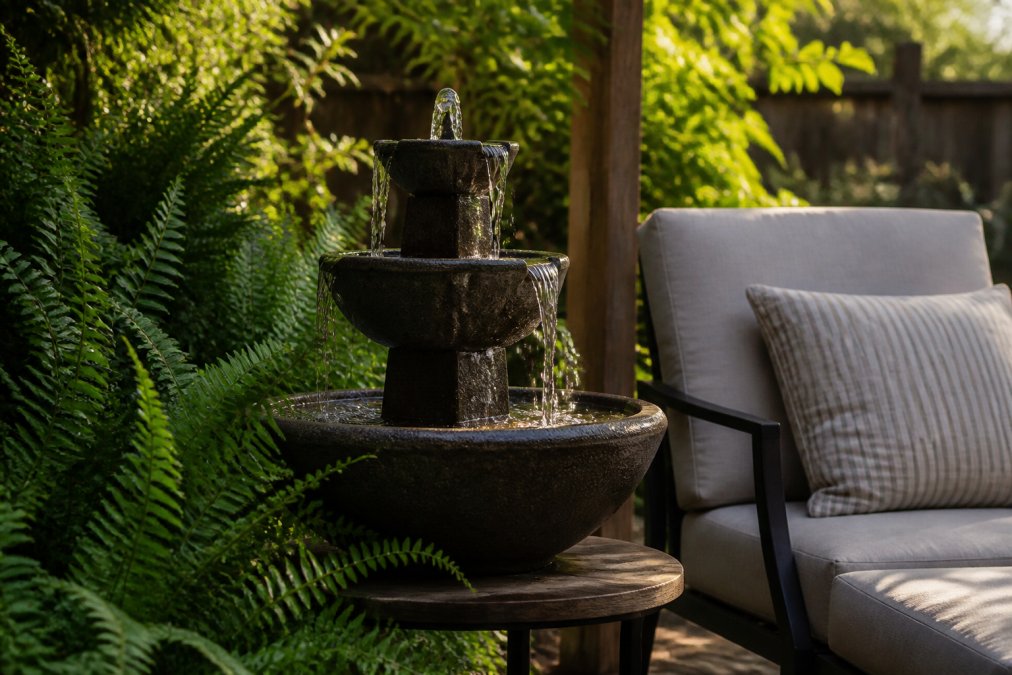
For water features, match the sound profile to your space: (extension.org)
- Dripping or trickling (small ceramic or copper tabletop fountains): Best for compact patios or balconies where a loud splash would overwhelm the space. The gentle plink creates a meditative, almost percussive rhythm.
- Gentle cascade (a spillway bowl or wall-mounted waterfall): Produces a soft, broad-spectrum white noise that covers mid-frequency sounds like conversation from a neighbor's yard.
- Bubbling urn or rock fountain: The burble is lower in pitch and carries well, making it ideal for masking low-frequency hums from air conditioners or heat pumps.
Choose wind chimes deliberately: aluminum produces a bright, bell-like tone that carries; bamboo creates a softer, hollow thunk. For a calming effect, tune chimes to a pentatonic scale, it lacks dissonant intervals, which is why it appears in so much relaxation music.
Scent-Based Planting: The Olfactory Layer
Scent is the sense most directly wired to memory and emotion (the NIH). Place fragrant plants where you sit, walk, and linger, not just along a fence line.
Plant in clusters of three or more of the same species; a single lavender plant is barely noticeable, but a 3-foot drift scents an entire seating area.
Consider these reliable performers for most of the United States:
- Lavender (English or French varieties): The classic relaxation scent. It thrives in full sun and well-drained soil. Crush a leaf between your fingers to release the oils, if you can smell it, it will work in the garden.
- Jasmine (star jasmine or Carolina jasmine): Its sweet, heady fragrance intensifies in the evening, making it ideal near a fire pit or evening lounge area. It is a vigorous climber, so give it a trellis or let it spill over a wall.
- Gardenia: A powerful, creamy scent that carries surprisingly far. It prefers acidic soil and partial shade, so amend with peat moss or sulfur if your soil is alkaline.
- Rosemary (trailing or upright): The herb's piney, resinous scent is both calming and clarifying. It is drought-tolerant once established and doubles as a culinary herb.
- Mint (spearmint or chocolate mint): Plant it in a container, it is aggressively invasive in the ground. The scent is released when you brush against it, making it perfect along a walkway.
Avoid strongly scented flowers (like lilies or hyacinths) under a bedroom window or near a dining table, their perfume can become cloying or trigger allergies. Reserve those for a distant corner where the scent drifts but does not dominate.

Visual Calm: Beyond Green and White
The color palette matters, but so does the pattern of what you see. A yard that is all one texture feels flat; too many contrasting textures feels chaotic. Aim for a repeating rhythm of form and color.
Choose one dominant foliage color, one accent color, and one texture contrast, repeating this trio in each garden bed for cohesion without monotony.
Ornamental grasses add a kinetic element, they sway in a light breeze, which the eye reads as calming. Position them where you will see them from your primary seating position, ideally backlit by afternoon sun.
How to Create a Private Backyard Oasis with Screening
Privacy is the non-negotiable foundation of any relaxing backyard. The goal of screening is to block sight lines from neighbors while softening the boundary. Strategic planting of evergreen shrubs like arborvitae or holly provides year-round coverage.
For immediate results, install a privacy screen using materials that complement your home's architecture. Cedar fencing offers a warm, natural look; powder-coated metal screens provide a modern aesthetic. Combining a solid fence with climbing vines adds softness and fragrance.
Choose Comfortable Seating and a Focal Point
Comfortable outdoor seating is the heart of the relaxing backyard. Prioritize deep-seated sofas and lounge chairs with plush, weather-resistant cushions. The 7 Piece Outdoor Patio Furniture Set with Fire Pit Table from Spirit of Willow combines a rattan wicker sofa and chairs with a central fire pit, extending usability into cooler evenings.
Every seating arrangement needs a focal point to anchor the eye. A fire pit serves this role brilliantly, offering warmth, light, and a visual centerpiece. Alternatively, a sculptural water feature, art piece, or specimen tree can draw attention.
Incorporate Outdoor Wellness Space Design
Outdoor wellness space design brings spa-level recovery home. The Backyard Discovery Paxton 4-6 Person Traditional Cedar Outdoor Barrel Sauna features a high-performance 9kW heater that reaches temperature faster than standard models, with Wi-Fi control for preheating from your phone.

Position wellness elements as a distinct zone, separated from dining and lounge areas. A sauna placed near a cold plunge creates a complete contrast therapy circuit. Even without a plunge, pairing the sauna with an outdoor shower and shaded lounging spot allows gradual cooling.
Set the Mood with Strategic Lighting
Lighting transforms the backyard after sunset. The goal is layered lighting that provides safety while casting warm, flattering pools of light. Avoid harsh, single-source floodlights that flatten the space and create glare.
Use a combination of lighting types to achieve depth:
- Path lights to guide movement along walkways
- Uplights on trees or architectural features to create vertical interest
- String lights or lanterns for a soft, overhead glow in seating areas
- Candlelight or a fire feature for a flickering, intimate effect
Dimmers allow you to adjust intensity based on the occasion. Solar-powered options reduce wiring complexity and energy costs, making them an easy choice for retrofitting existing spaces.
Modern Backyard Design Ideas 2026 for Low Maintenance
The 2026 shift is toward climate-appropriate, self-sustaining landscapes that need intervention only a few times per year.
The Maintenance Audit: Know Your Real Cost
Calculate your current maintenance burden. Most homeowners spend 2-4 hours per week on yard work during the growing season, 100+ hours a year (statista.com). Identify your top three time sinks and target those first.
Climate-Specific Design: The Missing Angle
No single plant palette works across the United States. A design that thrives in the Pacific Northwest will struggle in Arizona, and a xeriscape that works in Colorado will rot in Florida's humidity. Here is how to adapt the low-maintenance principle to your region.
Hot and Arid Climates (Desert Southwest, Inland California)
- Hardscape ratio: Push hardscape to 60-70% of the yard. Decomposed granite, flagstone, and concrete pavers replace water-hungry lawn entirely.
- Plant selection: Agave, yucca, desert spoon, and palo verde trees. These need water only during the first two establishment years; after that, they survive on rainfall alone.
- Shade strategy: A ramada or shade sail is essential, not just for comfort but to reduce evaporation from any planted areas. Position it to shade the west side of the house in the afternoon.
- Irrigation: Drip irrigation on a smart controller (like a Rachio or Orbit B-hyve) that adjusts to local weather data. Set it to water deeply but infrequently, once every 10-14 days in summer, to encourage deep root growth.
Hot and Humid Climates (Southeast, Gulf Coast)
- The enemy is moisture, not heat: Choose plants that resist fungal diseases. Native options like wax myrtle, sweet pepperbush, and dwarf palmetto thrive without supplemental watering once established.
- Lawn reduction: Replace St. Augustine grass (which needs mowing every 5-7 days in summer) with a hardscape patio or a groundcover like frogfruit or sunshine mimosa, which stay under 3 inches tall and need mowing only once or twice a year.
- Airflow is critical: Do not create solid walls of vegetation, humidity gets trapped and promotes mildew. Use open slat fencing or spaced plantings to keep air moving.
- Material warning: Avoid untreated wood that will rot in the humidity. Choose powder-coated aluminum, composite decking, or naturally rot-resistant species like ipe or cedar with a proper sealant.
Cold and Snowy Climates (Upper Midwest, Northeast, Mountain West)
- Winter is the real test: Your yard must look intentional under snow for 4-5 months. Use evergreen structure (arborvitae, juniper, boxwood) as the backbone, and place hardscape elements like a fire pit or pergola where they remain visible and usable after shoveling.
- Freeze-thaw cycles: Choose permeable pavers or gravel over solid concrete, heaving is a common problem. If you use concrete, ensure it is poured on a proper 4-6 inch gravel base with rebar.
- Plant hardiness: Stick to native perennials rated for your USDA zone (check the zone map, not just the nursery tag). Ornamental grasses like little bluestem and switchgrass provide winter interest and need cutting back only once in early spring.
- Snow load: If you add a gazebo or pergola, verify it is rated for your local snow load (typically 30-50 pounds per square foot in the Northeast). A structure that collapses under snow is the opposite of relaxing.
The 80/20 Rule of Plant Selection
Choose 80% of your plants from proven, low-maintenance natives for your region, and allow only 20% for "wow" specimens that need extra care. Native plants need no fertilizer, minimal water, and no pesticides once established. Your local state extension service publishes free native plant lists.
Hardscape Materials That Age Gracefully
Low maintenance is also about materials that do not need refinishing, sealing, or replacing:
| Material | Maintenance Requirement | Lifespan | Best Climate Fit |
|---|---|---|---|
| Powder-coated aluminum | Wipe down occasionally | 20+ years | All climates |
| Hand-woven PE wicker | Hose off; UV-resistant | 10-15 years | All climates |
| Naturally rot-resistant cedar | Re-seal every 2-3 years | 15-20 years | Dry to moderate |
| Composite decking | Wash annually | 25+ years | Humid, wet |
| Permeable concrete pavers | Sweep; re-sand joints every 5 years | 20+ years | Freeze-thaw zones |
| Decomposed granite | Top up every 2-3 years | Indefinite | Arid |
The 2026 Shift: Regenerative, Not Just Low-Maintenance
The most forward-looking designs create systems that improve the local environment. Rain gardens capture stormwater runoff and filter it naturally. Pollinator patches attract beneficial insects that control pests without chemicals. A small patch of clover lawn stays green without watering and fixes nitrogen in the soil. These elements require an initial setup but then become self-sustaining ecosystems.
The 10' X 12' Wooden Gazebo from Spirit of Willow fits this philosophy: its galvanized steel roof sheds snow and rain without maintenance, and the cedar frame weathers naturally to a silver patina requiring no sealing. Pair it with a native plant bed and decomposed granite base for a corner that asks nothing of you for years.
| Design Element | Primary Benefit | Maintenance Level | Best For |
|---|---|---|---|
| Native plant beds | Low water use, supports local wildlife | Low | Eco-conscious homeowners |
| Permeable paver patio | Stormwater management, clean look | Low | Reducing lawn area |
| Hardtop gazebo | Year-round shade, weatherproof | Low | Defining a dining zone |
| Container gardening | Flexibility, easy to rearrange | Medium | Renters, small patios |
Conclusion: Your Path to a Calmer Backyard
Designing a relaxing backyard is a process of thoughtful elimination, not accumulation. By starting with a clear layout, layering in sensory elements, and prioritizing privacy and comfort, you create a space that actively reduces stress. The shift toward low-maintenance, climate-appropriate design ensures your sanctuary stays beautiful without demanding constant attention.
At Spirit of Willow, we curate pieces that combine comfort, atmosphere, and elevated design to help you build this vision. From the warmth of a fire pit table to the restorative power of a cedar barrel sauna, our collection is built to withstand the elements. Create a relaxing backyard that becomes your favorite destination, and continue shopping to find the perfect finishing pieces.
Frequently Asked Questions
How do I design my backyard layout for maximum relaxation?
Start by dividing your space into distinct zones based on how you plan to use it. Create a dedicated seating area for conversation, a quiet corner for reading or meditation, and separate spaces for dining or activity. Use pathways to connect these garden rooms naturally. The goal is to create a relaxing backyard layout that feels open and intentional, not cluttered. Measure your space first and sketch a simple map to visualize the flow before you start moving furniture or planting.
What are the best landscaping ideas for a peaceful backyard?
Focus on a calming color palette using greens, soft whites, and lavender tones. Incorporate native plants and succulents for texture contrast, which require less water and maintenance. A water feature, like a small fountain, adds the soothing sound of running water which is a proven stress reliever. Strategic planting also contributes to privacy, helping to block out street noise and create a true sanctuary. Remember that a well-planned layout with clear focal points feels more peaceful than a crowded space.
How can I make my backyard feel cozy and private?
To create a private backyard oasis, start by defining your boundaries. Install a privacy screen, tall fencing, or use vertical gardening with climbing plants to shield the space from neighbors. Add an outdoor rug to define your seating area and make it feel like an extension of your home. Layer in soft lighting, like string lights or lanterns, to create a warm ambiance after sunset. These elements work together to enclose the space, block visual noise, and make it feel like a secluded retreat.
What features are essential for a wellness-focused backyard?
Outdoor wellness space design centers on features that promote physical and mental recovery. A dedicated area for a home sauna or cold plunge is a powerful addition for recovery and stress relief. Complement this with a comfortable seating arrangement where you can rest and relax. Incorporate natural elements like water features and quiet zones for meditation or stretching. The goal is to create a relaxing backyard that supports your health routine without requiring a trip to a spa.