

Low-Maintenance Backyard Landscaping for Busy Homeowners
Table of Contents
- Why Low-Maintenance Backyard Landscaping Matters for Busy Professionals
- Hardscaping vs Softscaping for Busy Homeowners
- Best Low-Maintenance Perennials and Ground Covers
- Incorporating Native Plants and Drought-Tolerant Landscaping
- Mulching and Weed Suppression Strategies
- Backyard Wellness Retreat Design with Minimal Upkeep
- Outdoor Living Spaces That Reduce Maintenance Work
- Frequently Asked Questions
Last Updated: September 26, 2026
Why Low-Maintenance Backyard Landscaping Matters for Busy Professionals
A thoughtfully designed low-maintenance backyard landscaping approach eliminates the constant demands of weeding, pruning, fertilizing, and watering, freeing weekends for relaxation and family, without sacrificing beauty or functionality.
The difference between high-maintenance and low-maintenance yards comes down to strategic planning: choosing climate-adapted plants, incorporating hardscaping to reduce planting areas, and installing efficient irrigation systems allows your yard to practically maintain itself.
Low-maintenance landscapes cost less to sustain because you're not constantly replacing plants or paying for professional services, while enhancing curb appeal and respecting your schedule.
Hardscaping vs Softscaping for Busy Homeowners
Hardscaping (patios, pathways, retaining walls, pergolas, decorative stone) and softscaping (plants, soil, mulch) must be balanced strategically for low-maintenance backyard landscaping.
Hardscaping should form the foundation of your design. Dedicating half a typical backyard to patios, pathways, and stone features cuts planting maintenance in half while providing year-round structure and visual interest.
The 7 Piece Outdoor Patio Furniture Set from Spirit of Willow, featuring hand-woven PE wicker and a 50,000 BTU fire pit table, creates a complete outdoor living zone requiring minimal upkeep, with durable materials resisting fading and moisture. This set includes a sturdy powder-coated steel frame and hand-woven PE wicker, ensuring long-lasting beauty and resilience in all conditions. The eco-friendly olefin cushion covers are UV-resistant and water-repellent, staying vibrant and durable. The plush, high-density 28D foam backrest cushion provides superior lumbar support, combined with ergonomic armrests and wide seating for hours of relaxation. The 2-in-1 50,000 BTU Propane Fire Pit Table delivers heat with easy piezo ignition.
Softscaping should focus on ground covers, native shrubs, and perennials requiring minimal intervention, with mulching to reduce weeds and moisture loss.
Best Low-Maintenance Perennials and Ground Covers
Select perennials and ground covers that thrive in your climate zone, require minimal watering once established, and resist local pests and diseases.
Coneflowers, black-eyed Susans, and Russian sage return yearly without replanting, tolerate dry conditions, and attract pollinators. Plant in groups of three to five for visual impact while reducing individual plant care.
Ground covers like creeping sedums, creeping thyme, and ornamental grasses require far less mowing than turf, suppress weeds naturally, and tolerate poor soil.
Native plants adapted to your region outperform exotic species, requiring less supplemental watering while supporting local ecosystems that naturally control pests. Build your planting plan around native species.
Incorporating Native Plants and Drought-Tolerant Landscaping
Native plants form the backbone of low-maintenance backyard landscaping, requiring minimal supplemental watering, fertilizer, or pest treatments once established.
Xeriscaping uses native plants, reduces turf, improves soil with organic matter, and implements efficient irrigation to create yards thriving on natural rainfall.
Drought-tolerant plants feature striking visual characteristics, silvery foliage, architectural branching, dramatic color changes, making low-maintenance backyard landscaping visually distinctive.
Group native plants by water needs (hydrozoning) so each plant receives appropriate water without waste and irrigation zones can run independently by season.
Mulching and Weed Suppression Strategies
Effective mulching is one of the most impactful practices for low-maintenance backyard landscaping, but timing and regional climate dramatically affect results. A 2-3 inch layer of mulch around plants suppresses weeds, retains soil moisture, regulates soil temperature, and gradually breaks down to improve soil structure (Mulching woody ornamentals with organic materials). Over time, this reduces your need for supplemental watering and eliminates tedious hand-weeding. However, the execution varies significantly by season and climate zone.
Seasonal Mulching Calendar
Apply fresh mulch in spring (after last frost) to prevent frost heave, establish weed barriers before growing season, and moderate soil temperature for tender growth.
Inspect mulch depth monthly in summer. In arid climates, mulch thins to 1-1.5 inches; in humid climates, it may compact and cause root rot. Add mulch if weeds emerge.
10' X 12' Wooden Gazebo,Patio Hardtop →
Apply mulch in late fall (after leaf drop, before hard freeze) to insulate perennial roots, prevent winter weeds, and protect plants from frost crack and snow damage.
In winter, check for mulch displacement in wet regions and fluff compacted mulch in arid climates to prevent fungal issues.
Choosing the Right Mulch for Your Climate
Organic mulch improves soil but decomposes in 12-18 months (warm climates) or 2-3 years (cool climates). Inorganic options suppress weeds but don't improve soil and can trap heat.
Use coarser wood chips in humid climates for air circulation, finer mulch in arid climates for moisture retention, and landscape fabric plus mulch in transitional climates.
Weed Suppression Beyond Mulch
Dense planting of low-maintenance perennials and ground covers, combined with hardscaping and seasonal mulching, reduces weeds from constant battles to occasional problems.
Apply landscape fabric and 3 inches of mulch in spring, top-dress in summer, and refresh to 2-3 inches in fall. This three-touch system takes 4-6 hours annually for 1,000 sq ft and eliminates herbicides.
| Strategy | Weed Reduction | Moisture Retention | Soil Improvement | Seasonal Effort |
|---|---|---|---|---|
| Mulch alone (annual refresh) | Moderate | High | Gradual | 2-3 hours/year |
| Landscape fabric + mulch | High | High | Gradual | 3-4 hours/year |
| Dense planting + mulch | High | Moderate | Minimal | 2 hours/year |
| Hardscaping + mulch | Very high | N/A | N/A | 1 hour/year |
Backyard Wellness Retreat Design with Minimal Upkeep
Transforming your backyard into a wellness retreat doesn't require constant maintenance when you design strategically. The most effective low-maintenance backyard landscaping for wellness incorporates three elements: a comfortable seating area, water features for ambiance, and strategic lighting that creates atmosphere without demanding attention.
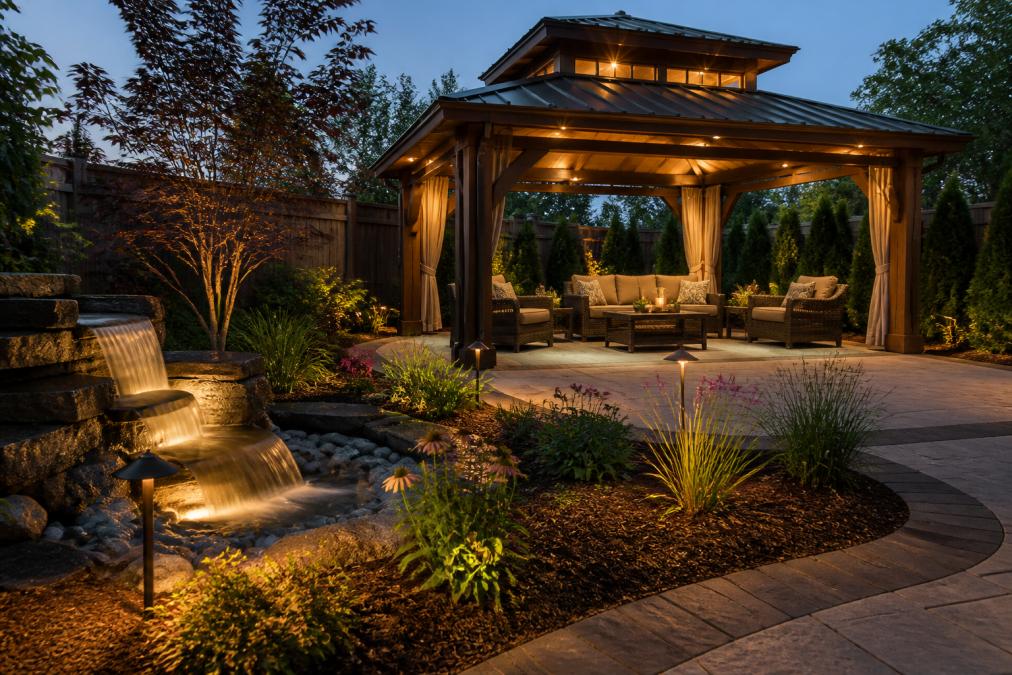
The 10' X 12' Wooden Gazebo from Spirit of Willow serves as the centerpiece for this design. Its solid wood posts and beams are pre-coated with a clear water-based finish, resisting rot, warping, and UV. The double-layer ventilated steel roof with anti-rust coating supports snow up to 70kg/m² and scatters direct sunlight, eliminating harsh glare. The smooth sealed wood surface resists dirt and wipes clean in seconds, with no yearly staining required unless you want to change the color. The gazebo creates a defined retreat space while the open design maximizes airflow and natural light, and its spacious 10x12 interior comfortably seats 6-8 people.

Water features enhance wellness spaces dramatically. The 37 In. Outdoor Cascade Fountain with LED lighting creates soothing ambient sound and visual interest without demanding maintenance.
Outdoor Living Spaces That Reduce Maintenance Work
Strategic outdoor living space design directly reduces maintenance demands on your low-maintenance backyard landscaping. When you define specific functional zones, dining, seating, pathways, you create clear boundaries that minimize the planting area needing regular care. However, the decision to build these spaces yourself or hire professionals significantly impacts both upfront cost and long-term maintenance.
DIY Installation vs. Professional Contractors: Cost-Benefit Analysis
Professional installation justifies its cost for:
- Hardscaping requiring drainage planning (patios, pathways, retaining walls)
- Irrigation system installation (improper slope causes water pooling; professionals ensure 1-2% grade)
- Structural elements (gazebos, pergolas, decks) where building codes and permits apply
- Landscape design that integrates multiple elements cohesively
Example breakdown for a 1,000-square-foot yard redesign:
- Professional patio installation (300 sq ft): $2,400-$4,500
- Professional irrigation system: $1,500-$3,000
- DIY perennial planting (200 sq ft of beds): $400-$800 in plants, 8-12 hours your time
- DIY mulching and maintenance: $200-$400 annually, 4-6 hours your time
- Total first-year cost: $4,500-$8,700 (hybrid approach)
- Versus full DIY: $2,000-$3,000 materials + $3,000-$8,000 in your time value
- Versus full professional: $8,000-$15,000
Design Principles That Minimize Ongoing Maintenance
Frequently Asked Questions
What is the most low-maintenance landscaping approach for a busy homeowner?
The most low-maintenance approach combines hardscaping (pavers, gravel, natural stone) with native plants, drought-tolerant perennials, and strategic mulching. This reduces watering, mowing, and weeding by up to 80% compared to traditional lawn-heavy yards. Focus on xeriscaping principles and ground covers that suppress weeds naturally, eliminating constant yard work.
What are the best low-maintenance perennials for low-maintenance landscaping?
Top choices include sedums, coneflowers, black-eyed Susans, Russian sage, and ornamental grasses. These perennials require minimal watering once established, resist pests, and return year after year without replanting. Pair them with slow-growing evergreen shrubs to create seasonal interest while keeping pruning and maintenance minimal.
Is hardscaping cheaper than traditional lawn landscaping in the long run?
Yes. While hardscaping has higher upfront costs, it eliminates ongoing expenses for mowing equipment, fertilizer, water, and lawn care services. Over 5-10 years, hardscaping saves thousands in maintenance labor and resources. A combination of hardscaping and drought-tolerant plants offers the best balance of curb appeal and cost savings.
How can I reduce yard work while keeping my backyard looking professional?
Install landscape fabric under mulch to suppress weeds, use drip irrigation for efficient watering, add hardscaping features like pavers or gravel beds, and choose slow-growing shrubs and native perennials. Include outdoor living elements like a gazebo or fountain to create visual interest without requiring plant maintenance. This approach maintains professional appearance with minimal weekly effort.