

Traditional Sauna vs Infrared for Detox 2026: What Works
Table of Contents
- Traditional vs Infrared Sauna: Quick Comparison Table
- How Traditional and Infrared Saunas Heat the Body Differently
- What the Science Says About Sauna Detox and Sweat
- How Long to Stay in a Sauna for Detox
- Sauna Session Best Practices for Safety and Comfort
- Sauna Health Benefits 2026: What the Evidence Supports
- Choosing a Home Sauna: Traditional vs Infrared Models
- Frequently Asked Questions
Last Updated: September 13, 2026
Traditional vs Infrared Sauna: Quick Comparison Table
The traditional sauna vs infrared for detox 2026 debate comes down to one uncomfortable truth: neither sauna removes meaningful amounts of toxins, but both support real cardiovascular and recovery benefits. This guide breaks down how each heats your body, what the evidence supports, and how to choose a model.
Sauna marketing claims infrared cabins "release stored toxins" and steam rooms "flush heavy metals through sweat." Most of it collapses under scrutiny. What survives is useful: sauna bathing raises core body temperature, drives vasodilation, and puts controlled thermal stress on the cardiovascular system. Those effects are worth paying for. The detox framing is not.
Below, we compare the two types across the factors that matter, then cover session timing, safety, and home setup.
| Factor | Traditional Sauna | Infrared Sauna |
|---|---|---|
| Heating method | Ambient air and steam | Radiant heat panels |
| Typical temperature | 160-190°F | 120-140°F |
| Warm-up time | 20-45 minutes | 10-15 minutes |
| Humidity | Adjustable, up to high steam | Low, dry air |
| Sweat onset | Fast, heavy | Slower, lighter |
| Electrical needs | Often 240V | Often 120V |
| Best for | Shared steam rituals | Smaller indoor spaces |
How Traditional and Infrared Saunas Heat the Body Differently
Traditional saunas heat the air around you; infrared saunas heat your body directly. That distinction explains nearly every practical difference, from warm-up time to how the session feels.

Ambient Air Heat vs Radiant Heat
A traditional sauna runs on an electric heater or wood-burning stove that raises the ambient temperature of the cabin. Your core temperature climbs because the surrounding air is hotter than you are. Adding water to the rocks creates steam, raising humidity and making the heat feel more intense at lower temperatures.
Infrared cabins work differently. Carbon or ceramic panels emit far-infrared and near-infrared wavelengths absorbed directly into tissue, producing deep tissue penetration without heating the air as much. The cabin might sit at 130°F while your skin feels considerably warmer.
What the Science Says About Sauna Detox and Sweat
Sweat is roughly 99% water, with the rest sodium, chloride, potassium, urea, lactate, and trace minerals. The idea that sauna bathing flushes heavy metals does not hold up when you look at what sweat contains and how the body clears toxins.
What Sweat Actually Contains
Eccrine sweat glands produce fluid primarily to cool you down; they are not a primary excretion organ. The body routes mercury, cadmium, lead, and arsenic through the liver and kidneys, which excrete them in urine or bile. Sweat carries only trace amounts of these metals, far too low to change your body burden.
That does not make sauna bathing pointless. It relocates the benefit. What you get from heat exposure is cardiovascular and nervous-system conditioning, not chemical purification. The CDC's guidance on heavy metal exposure is clear that clinical chelation is reserved for confirmed poisoning under medical supervision, which tells you how far a hot room sits from that process.
The FDA's consumer information on detox products makes a similar point: products promising to remove toxins through sweat are not supported by the evidence regulators have reviewed.
The Heat Shock Protein Mechanism
Here is where the real science lives. When core temperature rises during a sauna session, cells produce heat shock proteins (HSPs), molecular chaperones that help other proteins fold correctly and survive thermal stress. This is a well-documented cellular response, not a marketing claim. Researchers study HSPs because they appear to play a role in how the body adapts to repeated heat exposure, one reason sauna bathing is framed as hormesis: a small, controlled stressor that triggers a beneficial adaptive response.
That adaptation is cardiovascular and cellular, not detoxification. The distinction tells you what to expect from a routine and what to stop expecting.
Skin Health: Cosmetic Effect, Not Cellular Detox
Skin purification claims deserve the same skepticism. Sweating can leave skin feeling cleaner and heat opens pores temporarily, but that is cosmetic, not cellular detoxification. The skin's barrier function keeps things out, not pushes toxins through. The sauna's contribution to skin is increased circulation and a temporary surface flush, not a deep cleanse.
Why the Detox Framing Persists
The detox narrative survives because it is profitable and because sweating feels like elimination. A heavy sweat session produces a tangible result, wet skin, a flushed face, a sense of having "released" something. The feeling is real; the interpretation is not. Sauna bathing supports circulation, recovery, and relaxation, and those benefits are worth paying for on their own terms.
How Long to Stay in a Sauna for Detox
The practical answer is 15 to 20 minutes per session for most healthy adults, two to four times per week. Longer is not better, and detox framing does not determine timing.
Session length depends on heat tolerance and sauna type. Traditional rooms at 170°F and above push people out faster than cooler infrared cabins. A sensible structure:
- First session: 10 minutes, to gauge your physiological response
- Standard session: 15-20 minutes in a traditional sauna, 20-30 in infrared
- Frequency: Two to four sessions per week for cumulative benefit
- Hydration: 16-20 ounces of water before you enter, more afterward
If you feel dizzy, nauseated, or your heart pounds uncomfortably, leave. Heat tolerance varies enormously, and no schedule matters more than how your body responds on the day.
Sauna Session Best Practices for Safety and Comfort
Sauna session best practices come down to hydration, timing, and knowing when to stop. Most home sauna problems trace back to skipping one of those three.
Start with water: drink before, during breaks, and after. Alcohol and sauna bathing do not mix, because alcohol impairs body-temperature regulation and raises fainting risk. Skip a session if you are ill, pregnant without medical clearance, or managing uncontrolled cardiovascular conditions.
Then think about the recovery window. What you do after the heat shapes how good you feel the next day.
Post-sauna recovery protocol:
- Cool down gradually for 5-10 minutes in a cool room, not a freezing plunge
- Rehydrate with water and a light electrolyte source
- Wait 30-60 minutes before a cold shower if you want the contrast effect
- Rest for 15 minutes before driving or heavy activity
- Log the session length and how you felt, to find your personal ceiling
Individualized health profiles matter more than generic rules. Someone on blood pressure medication, someone training for a marathon, and someone managing anxiety have different tolerances and goals. If you have a diagnosed condition, get medical clearance before making sauna bathing a routine.
Sauna Health Benefits 2026: What the Evidence Supports
Sauna health benefits 2026 research continues to point toward cardiovascular health and recovery rather than detoxification. The strongest signals involve circulation, thermal stress adaptation, and relaxation, and benefits differ by person and goal.
Regular sauna bathing raises heart rate and increases circulation in a way that resembles mild cardiovascular exercise, which is why researchers keep returning to it as a topic. The National Center for Complementary and Integrative Health notes that heat therapies carry real physiological effects and real cautions, particularly for people with heart conditions. Heat shock proteins, which help cells manage stress, are among the mechanisms researchers study in this area.
Sauna Benefits by Health Profile
Most guides treat "sauna user" as a single category. It is not. The right protocol, temperature, and frequency shift with your goal and your body. Here is how benefits break down by profile.
Athletes and active adults. The primary draw is recovery. Heat exposure increases blood flow to skeletal muscle, which can help clear metabolic byproducts after training and reduce perceived soreness. A common pattern is a 15-20 minute session within a few hours of a workout, followed by rehydration. The cardiovascular load also adds a mild conditioning stimulus on rest days.
Older adults. Circulation support and relaxation are the headline benefits. Heat tolerance declines with age, and some medications, particularly blood pressure drugs, alter how the body handles thermal stress. A shorter session at a lower temperature, seated, with a companion nearby, is the safer start. Medical clearance is not optional.
People managing chronic inflammation or autoimmune conditions. This is where the evidence is thinnest and the marketing loudest. Some users report symptom relief from regular heat exposure, and anti-inflammatory signaling tied to heat shock proteins is a legitimate area of study. But sauna bathing is not a treatment for any diagnosed inflammatory condition and should not replace medical care. Treat it as a comfort measure and clear it with your physician.
People managing anxiety or sleep disruption. Evening sessions are the most commonly reported win. The post-sauna drop in core body temperature appears to support sleep onset, and the enforced stillness works as a screen-free decompression window. The benefit is real but modest, a routine, not a cure.
What You Should Not Expect
What you should not expect is measurable toxin elimination. Frame your purchase around relaxation, recovery, and routine. The benefits reported most consistently are deeper sleep after evening sessions, reduced muscle soreness after training, a reliable way to decompress, and improved relaxation and mood.
Choosing a Home Sauna: Traditional vs Infrared Models
Choosing between the two comes down to space, electrical capacity, and how you want to use the room. Traditional models suit outdoor installations and shared steam rituals. Infrared suits indoor spaces with standard wiring.
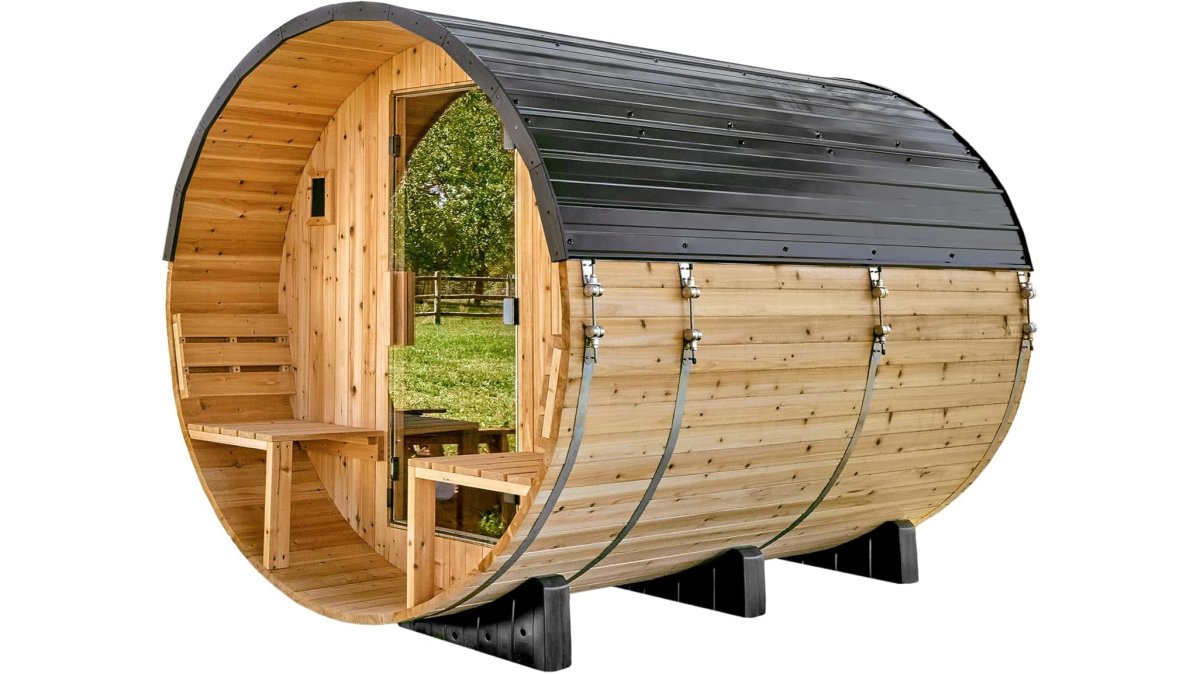
Traditional options. The Backyard Discovery Paxton 4-6 Person Traditional Cedar Outdoor Barrel Sauna at $5,566.08 pairs a PrairieFire 9kW electric heater with cedar construction, a Wi-Fi control panel for preheating, tongue-and-groove joinery, and an 8mm tempered glass door. It supports both dry heat and traditional steam sessions and comes with rocks, a bucket, and a ladle. A more budget-conscious outdoor route is the 4-6 Person Wooden Steam Sauna at $3,835.35, with a 6KW heater, dual dry and steam function, and a smart control system.


Infrared option. The Barcelona Far Infrared Sauna at $2,350.81 is a two-person indoor cabin built from Canadian hemlock with six low-EMF carbon panels, a roof vent for airflow, Bluetooth audio, and a 120V connection that runs on a standard household circuit. It is the easiest of the three to install and the simplest to live with in a smaller home.
One factor buyers overlook: maintenance. Traditional saunas see heavy sweat and steam, so cedar benches need wiping after each session and rocks rinsed periodically. Infrared cabins run dry, less moisture damage, more dust on panels. Neither is high-maintenance, but outdoor units need seasonal roof and wood-finish inspection.
The hard part of buying a sauna is not choosing a heater type. It is committing to a routine you will keep and picking a unit that fits your space without becoming a project. Spirit of Willow curates home saunas built for exactly that: the Paxton barrel sauna with its faster-heating 9kW heater and Wi-Fi preheat, the 4-6 person wooden steam sauna for shared sessions, and the Barcelona infrared cabin for compact indoor spaces. Each ships with the accessories you need to start. Continue shopping with Spirit of Willow and turn an unused corner of your home into a genuine retreat.
Frequently Asked Questions
Which type of sauna is best for detox?
Neither type removes toxins beyond what your liver and kidneys already do. Both traditional and infrared saunas make you sweat, and sweat carries trace amounts of heavy metals like mercury and cadmium, but the amounts are small. Traditional saunas run hotter (often 160-190 F) and produce more sweat volume, while infrared saunas heat the body directly at lower air temperatures. Pick based on comfort and how much you plan to use it, not detox claims.
How long in the sauna to remove toxins?
Most guidance suggests 15-20 minutes per session for traditional saunas and 20-30 minutes for infrared, with 1-3 sessions per week. Longer is not better. Sweat glands do release small amounts of heavy metals, but your body clears most toxins through the liver, kidneys, and digestive system. Treat sauna time as a circulation and relaxation practice, not a primary detox method.
Do infrared saunas provide the same cardiovascular benefits as traditional saunas?
Research on sauna bathing shows cardiovascular benefits from both types, linked to increased heart rate, vasodilation, and improved circulation. Traditional saunas produce a stronger thermal stress response because of higher ambient temperatures. Infrared saunas achieve a similar physiological response at lower heat, which some people find easier to tolerate. If you have heart conditions or take medication, talk to your doctor before starting.
What should I consider when installing a home sauna for wellness?
Check your electrical setup first: many traditional outdoor saunas need a 240V/50-amp connection, while some infrared models run on a standard 120V outlet. Consider space, indoor vs outdoor placement, and how many people will use it. A 4-6 person traditional barrel sauna like the Paxton suits families and entertaining, while a 2-person infrared unit fits smaller indoor rooms. Factor in maintenance and ventilation too.