

Smart Outdoor Lighting for Home Security
Table of Contents
- Why Smart Outdoor Lighting Matters for Home Security
- How Motion Sensors Work in Outdoor Security Lighting
- Best Motion Sensor Outdoor Lights for Your Perimeter
- Outdoor Security Lighting Placement Tips for Maximum Coverage
- Smart Home Integration for Exterior Lights and Security Systems
- Energy Efficiency and Durability in Outdoor Security Lighting
- Security and Privacy Considerations for Smart Outdoor Lighting
- Frequently Asked Questions
Last Updated: September 23, 2026
Why Smart Outdoor Lighting Matters for Home Security
Smart outdoor lighting security is no longer a luxury, it's a practical layer of your home's defense system. When motion sensors detect movement around your property after dark, they activate floodlights that eliminate hiding spots and deter intruders before they approach your doors or windows. This immediate response creates a perimeter of visibility that traditional static lighting simply cannot match.
Smart outdoor lighting solutions operate on schedules, respond to motion, and integrate with your home automation ecosystem. You can simulate occupancy while away, receive real-time alerts, and adjust settings remotely, transforming outdoor lighting from decorative to functional.
At Spirit of Willow, we curate products designed to work together, creating outdoor spaces that are both beautiful and secure. The right smart outdoor lighting security strategy makes the difference between a vulnerable exterior and one that actively discourages intrusion.
How Motion Sensors Work in Outdoor Security Lighting
Motion sensors detect infrared radiation from moving objects and trigger lights to flood the area with lumens. Most have adjustable sensitivity settings to fine-tune detection range and reduce false triggers from animals or debris.
Placement and configuration matter enormously. A sensor pointed at the street triggers constantly from traffic; one covering your front door and driveway catches actual threats. Look for adjustable sensitivity and detection zone angles to customize coverage without nuisance activations.
Dusk-to-dawn sensors use ambient light detection to activate lights at sunset and deactivate at sunrise. Combined with motion detection, they create a responsive security environment that adapts to both time and activity.
Best Motion Sensor Outdoor Lights for Your Perimeter
Spirit of Willow offers outdoor lighting solutions that balance security effectiveness with design sophistication. The 2 Pack Solar Lanterns Outdoor Waterproof at $22.56 delivers practical security without sacrificing aesthetics. These units feature auto on/off functionality triggered by dusk-to-dawn sensors, with an IP65 weatherproof rating that withstands rain, dust, and temperature extremes. The monocrystalline solar panel charges quickly even in cloudy conditions, providing 10-12 hours of lighting per night.

The Solar Lanterns Outdoor with 3000K LED and IP54 Rating at $173.49 offers remote control up to 26 feet, timer functions, brightness adjustment, and an E26 socket for quick bulb swaps.
The 9712PB Bay Shore Outdoor Wall Light at $302.04 and 9913PB Bay Shore Post Mount at $580.50 feature LifeBrite Polished Solid Brass construction, U.L. wet-location rating, and timeless design.
| Product | Type | Price | Best For | Key Feature |
|---|---|---|---|---|
| 2 Pack Solar Lanterns | Solar-powered | $22.56 | Budget-conscious security | Auto on/off, IP65 weatherproof |
| Solar Floor Lamp 3000K | Solar with remote | $173.49 | Adjustable control | Remote 26 ft range, dimmable |
| Bay Shore Wall Light | Hardwired brass | $302.04 | Entry points | Wet location rated, timeless design |
| Bay Shore Post Mount | Hardwired brass | $580.50 | Perimeter posts | Professional appearance, durable |
Outdoor Security Lighting Placement Tips for Maximum Coverage
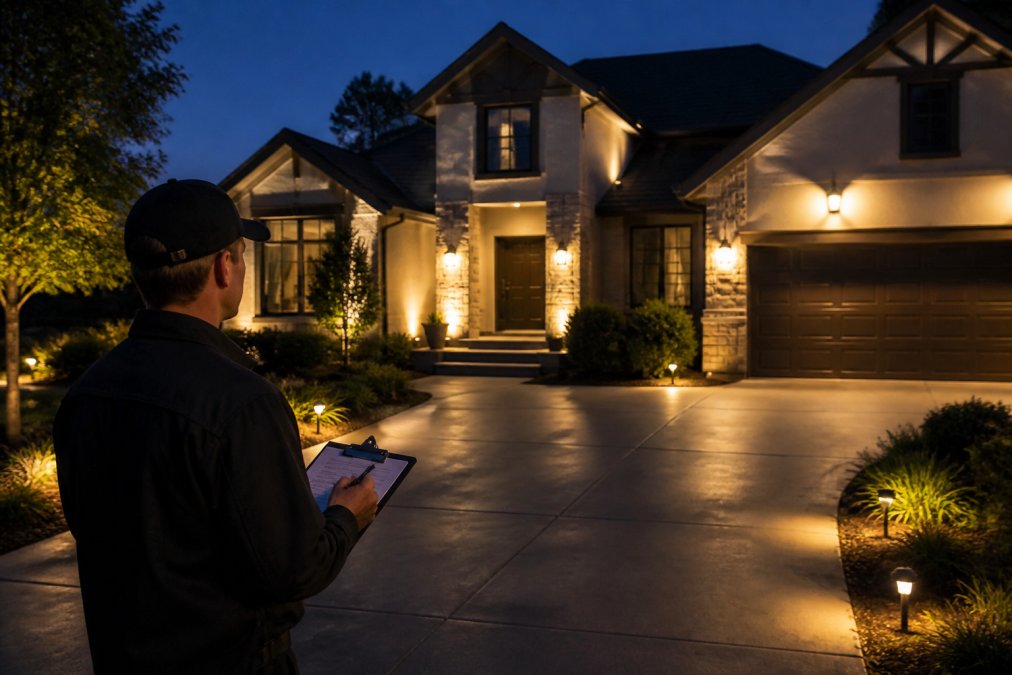
Don't treat outdoor security lighting as decorative illumination. Create zones of visibility around entry points and eliminate shadows where intruders could hide. Position lights beside doors, near windows, along side pathways, and at corners. Sensor configuration determines whether your system works or becomes frustrating.
Height, Angle, and Detection Zone Geometry
Mount lights 8-10 feet high with sensors angled downward at 45 degrees to cover entry areas without glare. Avoid pointing sensors at streets or neighbor properties to prevent false activations and light trespass.
Most sensors have a 20-40 foot range and 90-120 degree angle. A 120-degree sensor covers wide arcs but may pick up street movement; a 60-degree sensor requires precise aiming. Test your actual detection zone by walking the perimeter at night and marking trigger boundaries to reveal dead zones.
Sensitivity Adjustment and False-Trigger Elimination
False triggers waste energy and dull deterrent effect. Most quality sensors have adjustable sensitivity and dwell time (how long lights stay on after motion stops).
Start with sensitivity at 50% and dwell time at 2-3 minutes. Observe for one week, then adjust: reduce sensitivity to 30-40% if false triggers occur, increase to 70-80% if it misses real movement. A properly calibrated sensor triggers for people but ignores traffic and animals.
Dusk-to-Dawn Sensors and Scheduling
Dusk-to-dawn sensors activate at predictable times. Add randomized scheduling (dusk ±15 minutes, dawn ±15 minutes) to break patterns while maintaining full-night coverage.
Overlapping Detection Zones and Perimeter Depth
Overlap detection zones slightly to eliminate gaps. A determined intruder tests for dark spots between coverage; thoughtful placement prevents this.
Layer your perimeter: boundary lighting (property edge), mid-perimeter (driveways, side yards), and home layer (doors, windows, decks). This forces intruders through progressively illuminated zones.
For a typical residential lot, this means:
- Perimeter layer: One motion light at the front corner of the property (or two if the lot is wide), covering the street-facing approach
- Mid-perimeter layer: Lights on the driveway (if applicable) and along side-yard pathways
- Home layer: Lights flanking the front door, covering rear entry points, and illuminating deck or patio areas
For properties larger than a quarter-acre, use multiple sensors with overlapping coverage rather than fewer high-powered lights.
Outdoor Lanterns for Porch, 13.2" Led →
Avoiding Light Trespass While Maintaining Coverage
Aim lights downward and inward toward your property. Use shields or baffles to block sideways spillage. Many fixtures include built-in shields; aftermarket options are inexpensive.
Warmer light (2700K) is less likely to scatter into neighboring properties. Cooler light (5000K) provides better camera visibility but seems harsh. 3000K is a good compromise for motion-activated security lights.
Smart Home Integration for Exterior Lights and Security Systems
Smart outdoor lighting security gains power when integrated with your home automation ecosystem. Wi-Fi connectivity and geofencing let you simulate occupancy automatically, lights activate when you leave, deactivate when you return.
Integration with security systems creates actionable intelligence. Motion events can arm additional sensors, log camera video, and send alerts with timestamp and location.
For security purposes, keep critical lighting on manual or app-based control rather than voice commands. An intruder within earshot could trigger lights by shouting commands.
Real-time alerts matter more than automated responses. Immediate notifications let you check cameras, contact authorities, or verify the cause, providing actual security benefit.
Energy Efficiency and Durability in Outdoor Security Lighting
LED bulbs consume 75-80% less energy than incandescent while producing equivalent brightness. A 5W LED matches a 50W incandescent and lasts 25,000+ hours versus 1,000 hours. Energy savings justify the initial investment within five years.
The 2 Pack Solar Lanterns charge during daylight and operate independently at night with no wiring or bills. Monocrystalline panels charge faster and perform better in cloudy conditions, though placement matters as much as technology.
IP54 is the practical minimum for outdoor lighting; IP65 is better for coastal or rainy areas. Corrosion-resistant materials like polished brass extend fixture life compared to painted steel.
Quality fixtures operate reliably from 5°F to 158°F. Cheap fixtures fail in extreme cold or heat when battery chemistry slugs or circuit components degrade.
Security and Privacy Considerations for Smart Outdoor Lighting
Smart outdoor lighting introduces cybersecurity risks that traditional fixtures don't have. Wi-Fi-connected lights can be hacked, disabled remotely, or compromised to suggest your home is vacant.
Sensor Spoofing and False Disabling
Attackers can jam wireless signals or spoof false patterns to mimic your schedule while disabling security. Mitigation: Choose systems using encrypted, rolling-code protocols. Ask manufacturers whether sensors use encrypted communication and rolling codes.
Network Reconnaissance and Home Pattern Analysis
Even if your lights aren't hacked, their usage patterns leak information. An attacker monitoring your Wi-Fi traffic or observing your light activation schedule can determine when you're home, when you're away, and which entry points you use most frequently. This reconnaissance happens passively, they don't need to break in, just observe. Mitigation: Use a separate Wi-Fi network for all outdoor security devices. This isolates them from your primary network and makes traffic analysis harder.
Firmware and Supply-Chain Vulnerabilities
Privacy Concerns Beyond Your Property
Data Storage and Cloud Access
Frequently Asked Questions
Does outdoor lighting actually deter burglars?
Yes. Intruders avoid well-lit properties because visibility increases detection risk. Motion-activated lights are especially effective, they create the impression of occupancy and startle potential intruders. Combined with other security measures, smart outdoor lighting significantly reduces break-in attempts. The key is consistent coverage of entry points and dark corners where someone could hide.
What features should I look for in smart outdoor security lighting?
Prioritize motion detection sensitivity, IP weatherproofing rating (IP54 or higher), brightness measured in lumens, and remote control capability. Dusk-to-dawn automation saves energy while maintaining security. Look for adjustable detection zones and timer functions to reduce false triggers. Integration with your smart home ecosystem ensures seamless automation and alerts.
Can smart outdoor lights be controlled while I'm traveling?
Yes. Most smart outdoor lights offer app-based remote control from anywhere with an internet connection. You can turn lights on or off, adjust brightness, set schedules, and receive real-time alerts if motion is detected. This allows you to simulate occupancy while away, which is a proven deterrent. Geofencing features automatically activate lights when you approach home.
Are there privacy or cybersecurity concerns with smart outdoor lighting?
Smart lighting systems connect to your home network, so use strong passwords on your account. Position cameras or sensors away from neighbors' properties to avoid privacy issues. Choose brands with regular security updates and encrypted data transmission. While risks exist, they're manageable with basic precautions, the security benefits typically outweigh the concerns for most homeowners.