

How to Maintain a Home Cold Plunge System
Table of Contents
- Understanding Your Cold Plunge System Components
- Daily and Weekly Maintenance Habits
- How Often to Change Cold Plunge Water
- Cold Plunge Water Sanitation Methods
- Water Chemistry and Quality Testing
- Troubleshooting Cold Plunge Chiller Issues
- Seasonal Care and Long-Term Storage
- Frequently Asked Questions
Last Updated: September 25, 2026
Understanding Your Cold Plunge System Components
To maintain cold plunge system performance, the system circulates water through filtration while a chiller maintains target temperature. Core components include a pump for circulation, a filter cartridge for debris removal, a chiller unit for cooling, and a sanitation system for safety. Most systems use either hard-sided tubs with integrated equipment or inflatable tubs with external chillers. Spirit of Willow's All-In-One system features a built-in compressor and ozone disinfection, eliminating external equipment needs. The filter cartridge traps sediment and organic matter, the chiller cools water, and the sanitation method prevents microbial growth and biofilm formation.

Daily and Weekly Maintenance Habits
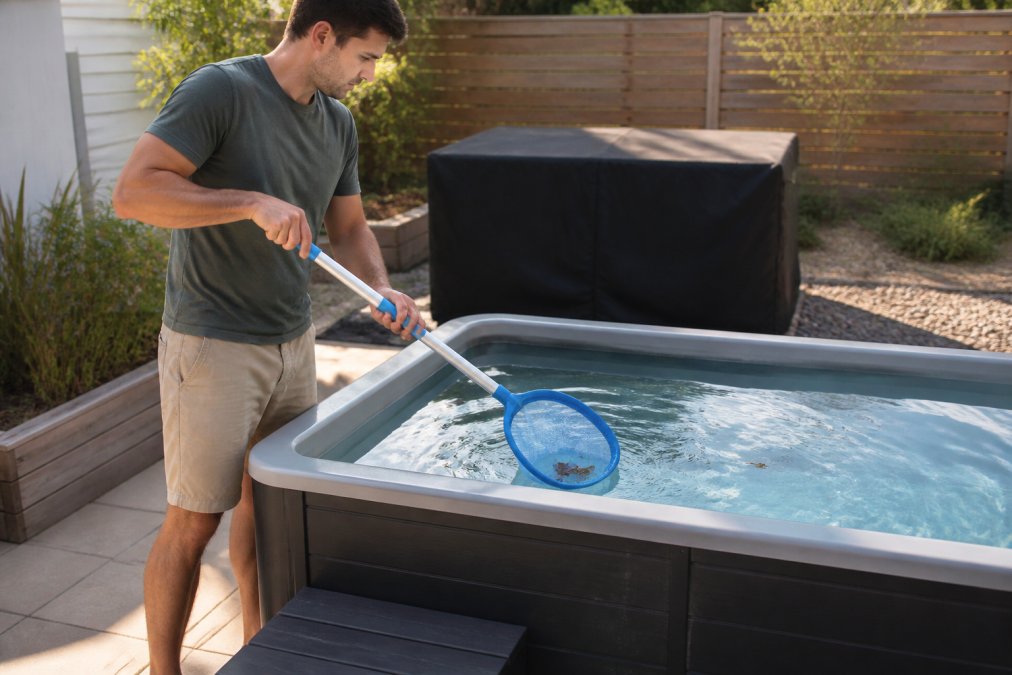
Daily maintenance takes minutes but prevents larger problems. Check water clarity each morning and remove visible debris with a pool skimmer net within 2 minutes. Leaves and organic matter feed algae growth. Verify your insulation cover fits properly without trapping moisture underneath.
Weekly maintenance includes testing water chemistry and inspecting equipment. Use test strips to check pH (7.2-7.8), alkalinity (80-120 ppm), and total dissolved solids (below 1,500 ppm). Inspect the pump and chiller visually, listening for unusual noises like grinding or squealing that indicate wear. Check hose connections for leaks and tighten any loose fittings.
How Often to Change Cold Plunge Water
Most home systems need a complete drain and refill every 3 to 4 months under regular use, though frequency depends on usage volume and sanitation method. Heavy daily use may require monthly changes; light weekly use might stretch to 6 months. Watch total dissolved solids as the primary indicator, when TDS exceeds 1,500 ppm, a drain and refill becomes necessary.
Chlorine-free ozone systems like Spirit of Willow's All-In-One keep water cleaner longer, extending intervals between full water changes. Drain during cooler weather when possible to avoid refilling with warm water your chiller must work harder to cool. Use a submersible pump or syphon to drain completely, then scrub interior walls to remove biofilm before refilling.
Cold Plunge Water Sanitation Methods
Water sanitation prevents microbial growth and keeps the environment safe. Chlorine-based sanitizers oxidize contaminants but create chloramines that cause irritation and require frequent monitoring. Ozone generators produce ozone gas that oxidizes contaminants more aggressively, breaks down into oxygen, and requires less frequent testing, but cost more upfront.
Hydrogen peroxide offers a middle ground, oxidizing contaminants and breaking down into water and oxygen, though it depletes quickly and requires frequent dosing. UV sterilization kills bacteria by damaging DNA but provides no residual protection and is typically paired with another sanitation method.
Test water chemistry twice weekly during the sanitation cycle, after the 24-hour equilibrium window. If sanitation levels drop faster than expected, biofilm may be forming in plumbing or the filter, requiring more aggressive cleaning. Consistent attention to these variables prevents long-term mineral buildup and hardware degradation, establishing a reliable foundation for managing water chemistry that remains essential for any aquatic system.
Water Chemistry and Quality Testing
Water chemistry determines safety, clarity, and comfort. Three measurements matter most: pH, alkalinity, and total dissolved solids.
pH and Sanitation Effectiveness
pH should stay between 7.2 and 7.8. Below 7.2, water becomes corrosive to equipment seals and metal fittings. Above 7.8, sanitation becomes less effective and cloudiness increases. If pH climbs despite adding pH decreaser, alkalinity is likely too high, address alkalinity first. Use test strips twice weekly and adjust with pH increaser or decreaser products. Wait 24 hours before retesting. Wild pH swings suggest low alkalinity or biofilm forming in circulation lines, signaling the need for filter cartridge replacement and plumbing inspection.
Alkalinity as a Diagnostic Buffer
Alkalinity acts as a buffer, preventing rapid pH swings. Target 80-120 ppm. Low alkalinity causes unpredictable pH fluctuations and faster sanitation depletion. High alkalinity makes pH difficult to adjust and often causes cloudiness. Test weekly and adjust gradually. If alkalinity is consistently high without your additions, your water source is naturally alkaline, plan for more frequent pH decreaser use and consider partial water changes every 2 months.
Total Dissolved Solids and the Drain Trigger
TDS accumulates from minerals and sanitation byproducts. When TDS exceeds 1,500 ppm, a drain and refill is necessary. Some systems allow partial water changes (25-50%) to reduce TDS without complete refill. TDS rising faster than expected, jumping 200+ ppm monthly, indicates heavy usage or hidden contamination. If usage hasn't changed, suspect biofilm consuming sanitation chemicals; replace the filter cartridge immediately and clean intake lines.
Microbiological Safety Testing
Test strips measuring free chlorine or ozone residual tell you whether sanitation is actually working. Zero residual means no active disinfectant, even if pH and alkalinity appear perfect, the most dangerous condition. Maintain 1-3 ppm free chlorine, 0.5-1.0 ppm ozone residual, or 50-100 ppm hydrogen peroxide during circulation. Ozone test strips are less common but available through pool supply retailers. If your ozone generator isn't producing measurable residual, it may be failing and requires professional inspection.
Maintaining a Testing Log
Keep a maintenance log recording pH, alkalinity, TDS, and sanitation residual readings. Patterns emerge over time: you'll notice if pH tends to rise or fall, whether TDS climbs predictably or spikes suddenly, and if sanitation residual drops faster than expected. Document the date, time, readings, adjustments made, and observations. After 3-4 months, you'll understand your system's rhythms and predict maintenance needs rather than reacting to problems.
Troubleshooting Cold Plunge Chiller Issues
The chiller is the most complex component. Before assuming failure, follow a diagnostic sequence that eliminates simpler causes first.
Inadequate Cooling: Diagnostic Sequence
- Verify the thermostat setting. Check the display or control panel.
- Check water flow. A clogged filter restricts flow. Replace the filter cartridge if it's been more than 30 days since the last change.
- Inspect intake and discharge hoses. Straighten kinked hoses and verify the intake isn't blocked.
- Check ambient temperature. Chillers are less efficient above 85°F. This is normal.
- Verify pump operation. Confirm the pump is plugged in and the circuit breaker hasn't tripped.
- Listen for compressor operation. You should hear steady humming. If silent, the control board may have failed.
If water still isn't cooling after these steps, the chiller likely has a refrigerant leak or compressor failure requiring professional service.
Unusual Noises: Diagnosis and Risk
Squealing indicates compressor bearing wear or refrigerant flow issues. Stop using the system immediately; continuing operation can cause complete failure. Most squealing requires professional service.
Grinding suggests internal compressor damage or a foreign object. Turn off immediately and do not restart.
Rattling might be loose mounting bolts or debris. Check that all visible bolts are tight.
Frost Buildup and Refrigerant Issues
Leaking Water from the Chiller
Power and Control Issues
If the chiller won't turn on:
- Verify the unit is plugged in and the outlet has power.
- Check the circuit breaker. If tripped, reset it. If it trips again immediately, there's an electrical fault, contact a technician.
- Check the control panel for error codes:
- Low flow error: Verify the pump is running and the filter isn't clogged.
- High temperature error: Verify water is flowing before restarting.
- Compressor fault: Requires professional service.
When to Call a Technician
Seasonal Care and Long-Term Storage
In freezing regions, winterize your system. Water expands as it freezes and can crack the tub or damage the chiller. Spirit of Willow's All-In-One system is winterized for outdoor use down to -20°F, but systems vary. If storing for winter, drain completely, remove and store the filter cartridge in a cool, dry place, and shut off the pump and chiller.
Frequently Asked Questions
How often should I change the water in my home cold plunge?
Most cold plunge systems benefit from a complete drain and refill every 3-6 months, depending on usage frequency and water quality test results. High-use systems may need more frequent changes. Monitor your water clarity and chemistry levels weekly using test strips. If total dissolved solids exceed 1,500 ppm or water clarity declines despite filtration, drain and refill sooner. Systems with effective ozone or UV sanitation can extend intervals, but regular water changes remain essential for removing accumulated sediment and maintaining optimal conditions.
What are the best chemical-free ways to keep cold plunge water clean?
Ozone generation and UV sterilization are the primary chemical-free sanitation methods. Ozone generators break down contaminants and prevent algae buildup without leaving residue. UV sterilization uses light to eliminate microbiological growth. Many all-in-one systems like the Fire Cold Plunge include chlorine-free ozone disinfection built-in. Combine these with strong water circulation, regular filter cartridge replacement, and debris removal using a pool skimmer. Pre-plunge showering also reduces the organic load entering the water, supporting cleaner conditions naturally.
What are the signs that my cold plunge filter needs replacing?
Replace filter cartridges when water flow decreases noticeably, water clarity becomes cloudy despite circulation, or pressure gauges on the system show elevated readings. Most cartridge filters last 3-6 months with regular use. Inspect cartridges monthly for visible debris, algae, or biofilm buildup. If you notice reduced cooling efficiency or the chiller working harder than usual, a clogged filter is often the cause. All-in-one systems like the Fire Cold Plunge include extra filter cartridges, making replacements convenient and affordable.
How do I prevent algae growth in an outdoor cold plunge?
Algae thrives in sunlight and stagnant water. Prevent growth by maintaining strong water circulation through your pump, using an insulation cover when the plunge isn't in use to block sunlight, and running your ozone generator or UV sterilization system consistently. Keep water temperature at 33-50°F, as algae grows more slowly in cold conditions. Test water weekly and address any green tinting immediately. Regular drain-and-refill cycles also reset conditions and eliminate persistent biofilm. Ensure your circulation cycle runs at least 4-6 hours daily.