

Home Sauna Electrical Requirements: 2026 How-to Guide
Table of Contents
- What You'll Need Before You Start
- Step 1: Match Heater Wattage to Voltage and Amperage
- Step 2: Size Your Sauna Heater Circuit Breaker Correctly
- Step 3: Follow NEC Code for Residential Saunas
- Step 4: Pull the Permit and Plan for Inspection
- Step 5: Budget for Electrician Cost for Sauna Installation
- Step 6: Account for Insulation R-Value and Heat Load
- Step 7: Add Smart Controls and Troubleshoot Common Errors
- Frequently Asked Questions
Last Updated: September 16, 2026
What You'll Need Before You Start
Getting the sauna electrical requirements for a home sauna right starts with knowing your limits. Most residential sauna projects require a dedicated circuit, a permit, and a licensed electrician for the final connection, so the prep work matters more than the wiring itself.
Before you touch anything, gather this:
- The sauna's installation manual and wiring diagram (your electrician will ask for both)
- Your home's load center details: available breaker spaces and total circuit capacity
- The wattage and voltage rating of your chosen heater
- A copy of your local electrical permit requirements, which vary by municipality
- A measuring tape for the run from panel to sauna location
Step 1: Match Heater Wattage to Voltage and Amperage
Heater size drives every other decision, so match wattage to your available voltage and amperage first. A heater that's too large for your circuit will trip breakers; one that's too small won't reach temperature in cold weather.
120V vs 240V: Which One Your Sauna Needs
Small 120V plug-in saunas exist, but they cap out around 1.5 to 2kW and heat slowly. Nearly every traditional 4-6 person sauna, including the Outdoor Traditional Sauna with 6KW Heater, runs on 220-240V. That higher voltage lets the heater pull enough wattage to reach temperature without drawing dangerous amperage on a 120V line.

Step 2: Size Your Sauna Heater Circuit Breaker Correctly
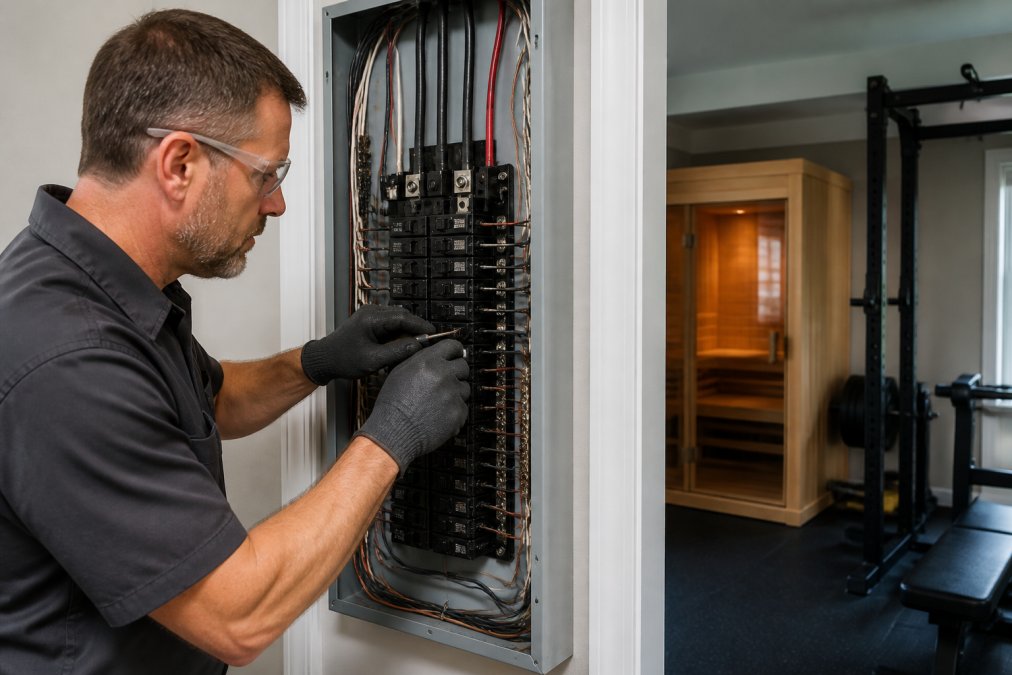
The correct sauna heater circuit breaker size depends on the heater's amperage draw plus the National Electrical Code's 125% continuous-load rule. Heaters run for long stretches, so the code treats them as continuous loads.
Step 3: Follow NEC Code for Residential Saunas
The NEC code for residential saunas treats a sauna as a wet location, which changes several requirements. The National Electrical Code (NEC) sets the baseline that your local building inspector will check against.
Key requirements include:
- A dedicated circuit with no other loads sharing it
- A grounding conductor bonded to the heater and any metal components
- GFCI protection where the code and local amendments require it for wet locations
- A safety disconnect within sight of the heater for service
- Wiring rated for damp or wet conditions, with proper conduit where exposed
GFCI, Grounding, and Wet Location Ratings
GFCI protection is the single most misunderstood requirement for saunas. Because steam and water are present, a wet location rating applies to fixtures and connections near the heater. Grounding is equally critical: the grounding conductor gives fault current a safe path, and skipping it is one of the most common DIY errors. Your electrician will confirm whether your jurisdiction requires GFCI on the sauna circuit specifically, as adoption varies.
Step 4: Pull the Permit and Plan for Inspection
An electrical permit is required for nearly every new sauna circuit, and skipping it creates problems at resale, at insurance renewal, and during any future panel upgrade. The permit process is straightforward once you know the sequence: apply with your local building department, list the scope of work, and schedule an inspection once the rough wiring is complete but before the walls close up.
Who Pulls the Permit, and When
In most jurisdictions, the licensed electrician who performs the work pulls the permit, not the homeowner, because the permit is tied to the license holder's insurance and bond. If you're doing a homeowner-exempt portion of the work (some states allow homeowners to wire their own primary residence), confirm that exemption in writing before you buy materials. A common pattern is that the homeowner can pull the permit but still needs a licensed electrician for the final connection and sign-off.
What the Inspector Actually Checks
Your building inspector will verify the items below. Walking through this list before you call for inspection prevents the most common fail-and-return cycle:
Outdoor Traditional Sauna, 4-6 Person →
- Dedicated circuit, no shared loads on the sauna breaker
- Breaker size, matched to the heater's continuous-load calculation, not just the nameplate amps
- Wire gauge, sized to the breaker, with no undersized runs hidden in the wall
- Grounding, the grounding conductor bonded to the heater, the control box, and any metal components
- GFCI, present where the adopted code cycle or local amendment requires it
- Disconnect, a safety disconnect within sight of the heater
- Box mounting and conduit, proper support, correct fittings, and damp/wet-location-rated materials where exposed
- Panel labeling, the new breaker clearly identified on the panel schedule
Rough-In vs. Final Inspection
Keep the signed inspection card and the permit number with your home records. When you sell, a buyer's inspector will look for evidence that the sauna circuit was permitted and inspected, and a missing paper trail can stall a closing or trigger a re-inspection at your expense.
Step 5: Budget for Electrician Cost for Sauna Installation
Electrician cost for sauna installation varies widely by region, panel condition, and run length, so get at least two written quotes before committing. The biggest cost drivers are whether your panel has spare capacity, how far the sauna sits from the panel, and whether you need a subpanel or upgraded service.
Step 6: Account for Insulation R-Value and Heat Load
Higher thermal insulation R-value means less heat loss, which lets a smaller heater do the same job. This is the step most guides skip, and it directly affects your heater load.
Step 7: Add Smart Controls and Troubleshoot Common Errors
Smart controls let you preheat from your phone, and they're now common on quality saunas. The Backyard Discovery Paxton Barrel Sauna includes a Wi-Fi panel and a 9kW PrairieFire heater that reaches temperature faster than a 6kW unit, which matters if you want a sauna ready when you walk outside.

The Electrical Side of Smart Controls
A Wi-Fi controller or remote-start module adds a small but real load to the circuit, and it changes how the sauna behaves on power-up. Three things to plan for:
- Standby draw. The controller, display, and any LED lighting pull a few watts continuously. That's negligible for the breaker, but it means the sauna is never truly off unless you install a disconnect or a switched feed.
- Control wiring vs. power wiring. Most smart panels use low-voltage control wiring to the heater contactor, separate from the line-voltage feed. Don't assume the controller can be fed from the same 240V circuit without checking the manufacturer's diagram, some require a dedicated 120V control feed.
- Wi-Fi range. Confirm your control panel's Wi-Fi signal reaches the sauna location before final mounting. A mesh node or extender near the unit solves most connectivity issues, and a sauna inside a metal-clad or foil-vapor-barrier structure will attenuate signal more than a wood-framed room.
GFCI vs. Standard Breaker: Clearing Up the Confusion
This is the single most misunderstood point in sauna wiring, and it's worth stating plainly. A GFCI (ground-fault circuit interrupter) protects people from shock by tripping when current leaks to ground, it is not the same as a standard breaker, and it is not a substitute for proper grounding. Whether your sauna circuit requires GFCI depends on the code cycle your jurisdiction has adopted and any local amendments.
Troubleshooting: What to Do When Something Goes Wrong
| Problem | Likely Cause | Diagnostic Step | Fix |
|---|---|---|---|
| Breaker trips immediately at startup | Short circuit or miswired heater element | Disconnect heater, reset breaker; if it holds, the fault is in the heater or its wiring | Electrician tests element and terminations |
| Breaker trips after 10-20 minutes | Breaker undersized for continuous load | Confirm the 125% continuous-load calculation against the actual nameplate amps | Resize breaker and wire together, never breaker alone |
| Heater never reaches temp | Poor insulation or undersized wattage | Check R-value and compare heater kW to room cubic footage | Improve insulation or upgrade heater |
| GFCI trips repeatedly | Moisture in a connection or a failing heater element | Isolate the circuit and test the element for leakage | Electrician dries and reseals connections or replaces element |
| Smart panel won't connect | Weak Wi-Fi at the sauna location | Test signal strength at the panel location with a phone | Add a mesh node or extender |
| Heater runs but no heat | Contactor not engaging or control wiring fault | Verify control voltage at the contactor coil | Electrician checks control feed and contactor |
For smart integration, mount the controller where it can reach Wi-Fi and where you can service it without dismantling the sauna. The U.S. Department of Energy's home electrical safety guidance is a useful reference for safe residential circuit practices, and your heater's installation manual will list the manufacturer's own troubleshooting sequence, follow that before improvising.
Frequently Asked Questions
What are the electrical requirements for a residential sauna?
Most home saunas need a dedicated 240V circuit with a double-pole breaker sized to the heater's wattage. A 6kW heater draws about 25 amps and typically needs a 30-amp breaker and 10-gauge wire. A 9kW heater needs a 50-amp breaker and 6-gauge wire. You also need a grounding conductor, a safety disconnect within sight of the heater, and a GFCI where the sauna is a wet location. Always confirm the exact specs in your sauna's installation manual before buying materials.
What size circuit breaker does a sauna heater need?
Sauna heater circuit breaker size depends on the heater's wattage and voltage. A 6kW, 240V heater pulls roughly 25 amps, so a 30-amp double-pole breaker works. A 9kW, 240V heater pulls about 37.5 amps, which requires a 50-amp double-pole breaker. Breakers are sized at 125% of the continuous load, so never match the breaker exactly to the amperage draw. Check your heater's nameplate or installation manual for the manufacturer's required breaker size.
Do I need a dedicated circuit for my home sauna heater?
Yes. A sauna heater is a continuous load and must run on its own dedicated circuit. Sharing a circuit with lights, outlets, or other appliances will trip the breaker and can overheat the wiring. The dedicated circuit runs from a double-pole breaker in your load center to a junction box or safety disconnect near the heater. If you are adding a hybrid sauna with both a heater and a control panel, confirm whether the manufacturer requires one circuit or two.
How much does an electrician charge to install sauna wiring?
Electrician cost for sauna installation varies by region, panel capacity, and run length. Expect to pay for a dedicated 240V circuit, a double-pole breaker, wire, conduit, a disconnect, and labor. If your load center has no open slots or needs an upgrade, that adds cost. Get at least two written quotes that itemize the breaker, wire gauge, permit, and inspection. A licensed electrician should also confirm your panel's available amperage before you buy a heater.